Andrea Fischer creates textiles

Chilean ARTIST AND PROMOTER Andrea Fischer is founder and president of Chile Crea Textil (Chile Creates Textile, or CCT), an emerging association of textile creators whose 40 members produce an amazing body of work.

Andrea Fischer preparing her installation piece.

Andrea is also Vice-President of the IberoAmerican Textile Network, and a very active teacher of fiber and weaving techniques.
Her beautiful installation, Suspended IV, was an invited work at the Palais de Glace National Palace for the Arts in Buenos Aires, Argentina in 2009 during the 5th WTA Biennial. This work is based on bird nesting research made by the artist, and features 800 fiber eggs suspended from 200 threads, plus 650 threads carrying almost 12000 egg fragments.
Visit Andrea’s web site at   www.andreafischer.cl

Andrea Fischer photographing her installation.

Palais de Glace, Buenos Aires, Argentina

SUSPENDED IV, by Andrea Fischer.

—Silvia Piza-Tandlich, translation

Award winning jewelry made of paper

Textile jewelry design is gaining popularity worldwide, and there are LatinAmerican artists who take it to levels beyond our wildest imagination. Take Luis Acosta, for example: WOW!

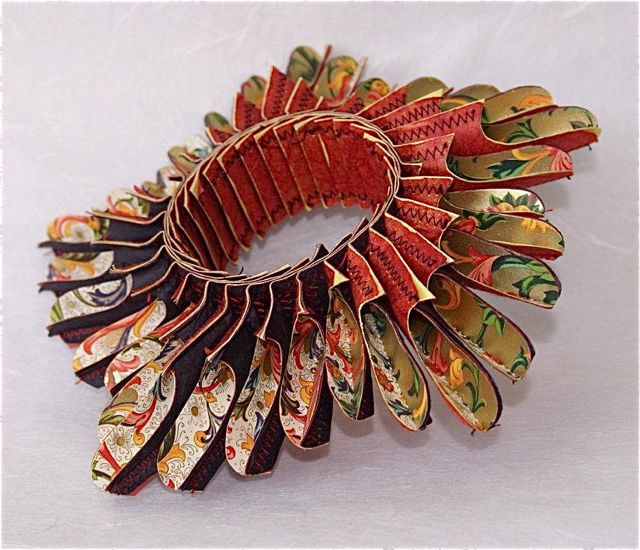
Luis Acosta: bracelet

Luis Acosta is originally from Córdoba, Argentina and lives in Holland. He studied weaving techniques at the Textile Department of the Gerrit Rietveld Academy in Amsterdam, where he graduated in 1988, but later committed his weft designs to paper. He made his first necklace in 1996 and, although it looked quite different from his present designs, it too, used the base of a relatively simple basic shape as starting point.

What he likes best about working with paper, is the infinite possibilities of combining colors and the different ways of working with paper sheets or paper threads. 

When asked where he gets his inspiration, he answers:

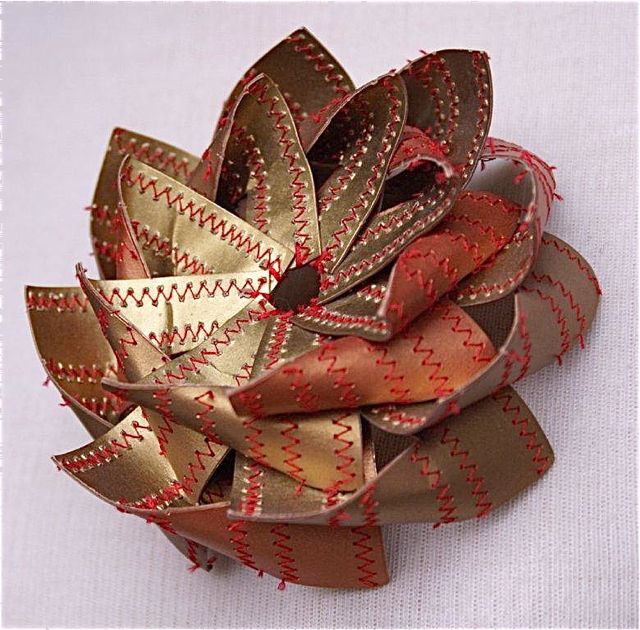
Luis Acosta: brooch

—”From simple forms I see daily everywhere. I develop a technique, draw a shape, and repeat, cut, and sew it.”


Luis Acosta: necklace

He has participated in group and individual exhibitions in most European countries, Argentina, USA, Japan and South Korea. There are works by Luis Acosta at the Museum of Arts and Design (New York, USA), Costume Museum (Buenos Aires, RA), Centre for the Arts Utrecht, The Textile Museum in Tilburg and in private collections in Argentina, Finland, India, Norway, Spain, Venezuela, USA and Netherlands.

Necklace by Luis Acosta

Luis is part of the circle of members of the LAKMA, Latin American Art Museum of Netherlands. We first met as affiliates to an association we both joined in 2008. At that time, he was volunteering a lot of time to see the Latin American LAKMA wing become a reality.
He teaches courses in textile design and designing women’s accessories in Argentina, USA, Spain and the Netherlands.
Also designs, weaves and creates three-dimensional textile works and installations in (handmade) paper; tapestries and fabrics;  women’s accessories in various materials, and paper jewelry.

Luis is one of the semifinalist recipients of Contemporary Art and Craft Awards in Barcelona. Finalists will be announced during the ArtFad award giving ceremony on July 5, 2011. These awards are part of FadFest—an event organized by FAD (Fostering Arts & Design organization). See more at http://www.bellevuearts.org/exhibitions/current/think_twice/index.html

Luis Acosta: necklace

Contact the artist:  http://www.luisacosta.nl


—Silvia Piza-Tandlich, translation

Cartago BORDADO under Colombian sun

Photograph: /www.bordadosdecartago.com/

Cartago, Colombia – Cartago, in the department of Valle del Cauca, is undoubtedly one of the world’s prolific embroidery cradles. This Colombian area about 180 miles southwest from the capital city of Bogotá, exemplifies the rural simplicity, beauty, and fun rhythm of Colombia. The town is known nationally and internationally for its excellent embroidered textiles and apparel by artists who are true maestros of thread and needle.

Embroidery in the Valle del Cauca has developed from generation to generation to the point of making it a much appreciated regional tradition. Entire families in Cartago are devoted to this craft, dividing design and embroidery tasks among family members who embellish blouses, skirts, headbands, ruanas (poncho-like coats), guayaberas (traditional tropical shirts), bed and table linens, and more.

History of Cartago Embroidery– Spanish conquistadors brought the first hand-embroidered items to Cartago—a city they founded in 1540.

Hand embroidery became an institution since 1890 when the Vincentine sisters began to teach it in the school they ran. At the beginning, in colonial times, Spanish women were responsible for continuing the art of embroidery. Later on, mestizo women adopted the tradition and established small family enterprises that gradually obtained national and international acknowledgement and fame.

Characteristics of “Cartagüeno”

(carta/weh/no) Hand Embroidery

Cartago embroidery uses the floral and geometric design that characterizes Andalusian embroidery.

Four basic stitches are prominent: flat, crossed, looped, and knotted. Almost a hundred stitches are derived from the above, among which the best known are: cross stitch, stem stitch, cord stitch, relief stitch, flat-pass stitch, sand stitch, double Bastille, crow’s foot stitch, arrow stitch, star stitch, and angel stitch, among others.

Lately, natural materials from the Colombian flora—mainly banana leaf fibers and fique sisal (a xerophytic monocot native to the Andean regions of Colombia) are being added to traditional embroidery and have become fashionable in the textile industry.

I leave you with this fun Colombian cumbia video of Cartago so you can chair dance!

—Silvia Piza-Tandlich, translation

Good-luck witches in Santiago, Chile

Award winning brooch by Alba Sepulveda

The Spanish conquista brought its religion to South America, and with the Inquisition a huge witchcraft lore began in Chile—from love-related persecution of famous women such as Francisca de Escobedo, Juana de Soto, Maria de Encío, and Juana de Castañeda all the way to two centuries of the Enchantment War, when Indigenous Mapuches were persecuted due to their costumes and tattoos.

During a trip to South America two years ago, I became aware of little witches hanging in vehicles and bicycles as good-luck charms in Santiago, Chile. This generalized belief has opened up a big market for textile figurines in every material imaginable.

A few weeks ago during an international crafts fair in “the witch’s town of Santa Ana”—west of the capital city of San José, Costa Rica—I met a Chilean finger weaver who works with crin (horse hair), and invited her and her son to spend a day at my place. This encounter was hard to accomplish due to tight schedules and travel distances, but it was very inspiring for me (I still work 100% by hand).

Of all the Chilean weavers working with horse hair, I was lucky to meet one whose work is exquisite, and whose original design has been internationally recognized.

Her name is Alba Sepúlveda. At age 7 she learned this ancient trade from her mother, Ms. Enriqueta Ramos, who wove the roots of the poplar tree. Many years later, the poplars became extinct in the area, forcing weavers to experiment with horse hair.

Alba Sepúlveda, horse hair dyed with aniline and agave ixtle

Nowadays Alba teaches 50 other women to weave, and the crin trade continues to grow: Finger weavers, who must have good sight and be able to spend hours working by a lightbulb. They harvest only the hair of breeds whose hair absorbs dye well, in a process that takes several days.

Alba Sepulveda, "Atom" brooch, Unesco Award

In 2008 Alba received the 2008 UNESCO Seal of Excellence for Handcraft Products award for the brooches shown here.

Alba Sepulveda's award winning "Black&White" brooch

Needless to say I am the proud owner of a little witch made by Alba, which is absolutely beautiful. It measures 4″ in length by 1.5″ in width, and it has tiny details delicately crafted with crin…wonderful! Unfortunately, my knowledge of finger weaving and knotting is very limited, and there’s no way I could remember all the explanations Alba gave me about this long process.

Alba Sepulveda, horse hair witch and necklace

Alba Sepulveda, Flowers

Alba lives in Santiago, Chile. If you’re interested in seeing or buying her works, you may visit her blog and newly designed web site:www.elartedelcrin.blogspot.com

www.elartedelcrin.cl

I love the artistry and intricacy of design in all of Alba’s works, which she brought over to my house that day.

Alba Sepulbeda: "Camelia"

Here are but a few samples for everyone’s enjoyment:

Alba Sepulveda: "Flower"

Alba Sepulveda: "Flores"

—Silvia Piza-Tandlich

6th WTA Biennial: Program

6th International Biennial of Contemporary Textile Art

World Textile Art – Air

Mexico, May 16 –June 3, 2011

The first Biennial event will be in Xalapa, a culture-oriented university town known as the “Veracruzan Athens,” sponsored by the Veracruzan University of Xalapa. In addition, the cities of Mexico DF and Oaxaca will also gather textile art creation, research, popular expression, management, and design personalities from all over the world.

INAUGURATIONS:

International Congress, “Considerations Between Textiles and Society: A Recapitulation”. May 16-19, offers 40 conferences from 28 nations, and five theme tables. Venue: Xalapa Anthropology Museum, May 16 at 7:00pm.

• Mexico DF exhibits: Museum Diego Rivera-Anahucalli, May 26 at 7:00pm.

• Oaxaca exhibits: Centro de las Artes de San Agustín (CaSa), May 28 at noon.

The program includes the following shows: Salon Mini-textiles . Salon Art Object. Salon Large Format. Salon Recyclability In Textile Art, and Salon Collaborative Nets. In addition, the list of parallel shows and workshops is extensive.

Hicks: A Life In Textile

It is a great honor to have Sheila Hicks—pioneer of contemporary textile art—as special artist at the Museum of Anthropology. Her exhibit, “A Life In Textiles” will pay homage to this important artist, who started 50 years ago and still continues to guide the direction of new artists. Hicks has very strong ties with South America since it was our tradition that attracted her to textiles. There is no doubt that Mexico made an impression as well, compelling her to live here for a while near the workshop she created. Mexico is where she had her first exhibit, and among her favorite techniques is the huipil chamula from the Chiapas area.

WTA is creating the Sheila Hicks award, Pioneer In Textile Work, which will be presented for the first time at the closing ceremony in Xalapa.

See the article about Sheila Hicks in American Craft Council Magazine:

Itinerant Artist: Sheila Hicks
Textiles legend Sheila Hicks has never stopped traveling the world and seeking new horizons in her work.

———————————————————————————————

The entire Biennial program can be found at www.wta–online.org

For more information: wta.aire.mexico@gmail.com

—————————

The exhibitions comprise

Large Format Salon: work by Ana Mazzoni, Argentina

a surprising number of renown LatinAmerican artists. I am posting a couple of “pre-show” works now, and promise to share more photographs as I receive them.

——————————————————————————————

Invitation: Exhibition “Thread To Thread” (Hilo a hilo), contemporary textile art from Spain.

Thread To Thread

Large Format Salon. Ariane Garnier, Costa Rica. "The Draft". Galvanized wire, embroidery on rubber and mosquito net. 150 x 100 x 100cm.

Beatriz Oggero: Colored Transparencies. Copper wire wrapped with sewing thread. Large Format Salon. 6th WTA Biennial of Contemporary Art.

—Silvia Piza-Tandlich
6th WTA Biennial: Going to Oaxaca?

My work will be displayed at the 6th WTA Biennial’s Salon for Recyclability In Textile Art in Oaxaca, Mexico as of May 28!!!

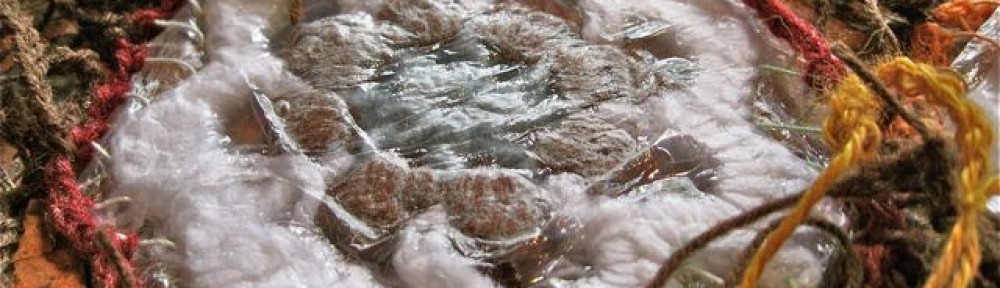
Silvia Piza-Tandlich: Molecular Composition. Recycled afghan, fused plastic, papel picado, crochet. 2011, Salon For Recyclability In Textile Art, Oaxaca. Photo: Martha Alvarez.

Aside from the obvious thrill of chatting with artists and meeting new people, Oaxaca will feature Carolyn Kallenborn’s premiere of her documentary, Woven Lives, at the Oaxaca Textile Museum on June 2nd, which I really wanted to see.

Unfortunately, making the trip from Costa Rica to Mexico is expensive, and as my husband’s voice of reason sadly tells me what I already know, he also proposes to find “ways to fill the void.”  He’s right!

DVD cover for Woven Lives

While nothing could fill the void of not attending our own exhibit’s inauguration, so it happens that Carolyn Kallenborn does have the film on DVD for sale, and I have already requested a copy.

It also occurs to me that Carolyn has to fly herself all the way to Oaxaca at whatever price airlines charge, and then fly to the SDA Conference where she’s also giving a lecture and showing the film. I therefore, urge everyone to buy the film, and I know we won’t regret it: It’s made in very good taste, contains a lot of valuable information, and the proceeds will help Carolyn continue this type of important research. Last week I posted the film’s trailer, and I’ve seen photographs of Carolyn’s life with this Zapotec textile community in Oaxaca. This film is must-see, must-have! You can go to her website and use the payment options available

Or you can go to Oaxaca and see the exhibits at the Casa de Arte de San Agustín (CaSa) as well as the Oaxaca Textile Museum film premiere. If you go, please take lots of photos and share them with me!

—Silvia Piza-Tandlich

6th WTA Biennial: Documentary in Oaxaca, Mexico

Woven Lives is Carolyn Kallenborn’s documentary to be shown on June 2nd at the Textile Museum of Oaxaca as part of the 6th WTA International Textile Biennial. The weavers who are in it will be seeing it for the first time, which will prove to be a very special moment for them.

Carolyn spent a considerable amount of time in Oaxaca working with these weavers, and has recently finished this wonderful documentary.

I was lucky to attend her witty and fascinating lecture last September at the Costa Rican-North American Cultural Center, where she talked about some of her experiences getting acquainted in Oaxaca, and showed photographs of her community work, as well as the video below.

After the Oaxaca premiere, Carolyn will be showing the film on June 10th at the SDA Conference in Minneapolis.

—Silvia Piza-Tandlich, translation

Greetings from Grace!

Grace Kawall, Myth&Religion, quilted painting

Grace Kawall at work

Grace Kawall is a multi-talented Brazilean textile artist living in Ubatuba, from where she spreads cheer around the world. She has had over 40 exhibits in the U.S. and other countries.

Her enthusiasm and intensity are contagious not only in her exuberant textile paintings—which she hand quilts—but in her beautiful home and landscape as well.

She will be visiting NYC soon, but in the meantime she sends the customary “big hug” (typical LatinAmerican style greeting), to all of us.

Um grande abraço, Grace!

Grace's works at Café Piu Piu in São Paulo

You can see more of Grace’s works in video form: www.youtube.com/watch?v=HZCuUa5aFuE

and at Grace’s site: http://ceciliakawall.ifp3.com/2/a5975

—Silvia Piza-Tandlich

Carolyn Kallenborn films Mexican textile community life

Woven Lives: Contemporary Textiles from Ancient Oaxacan Traditions examines how traditional art and design play an active role in the cultural sustainability of the Zapotec communities in Oaxaca. This documentary, which traces the development of the weaving process from the first people in the valley to the present day, uniquely blends the perspectives of art, design, business, history, ethnic studies and cultural anthropology. While the textiles are the centerpiece of the film, it highlights the life around the production that creates a sense of connection to the culture, the community, the past and the future.

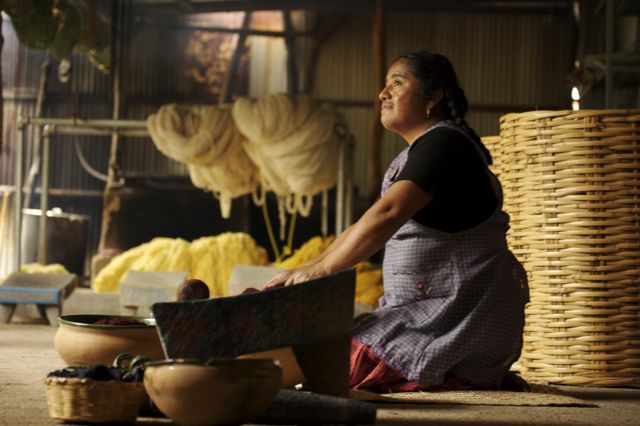
Textile creator in Oaxaca, Mexico.

The weaver’s work is filled with color and textures from dyes and yarns. The meditative movement of the spinning wheel and swift work of the weaver’s expert hands show a rhythm of motion at the loom that has been going on without interruption for centuries. The workroom is filled with the clack of the looms, the noise of the chickens in the yard, and the voices of the weavers as they speak with pride of their work. Photos can capture an instant. Written words can describe the scene and pass on tremendous amounts of information, but only through movement, color and sound can one really communicate the experience of the process, their connection to their culture and the beauty of their extraordinary textiles.

Visit the website
Documentary Film by Carolyn Kallenborn

6th International CIPED Congress in Portugal

6th International Congress on Research & Design

Evelise Ruthschilling from Brazil (SDA member since 1989), has been busy preparing for the 6th International Congress on Design & Research, Portugal.

Evelise teaches Art & Design at the Federal University of Rio Grande do Sul (UFRGS). You can see Evelise’s textile work by visiting her site at   www.contextura.art.br

A Second Call for Papers is now open until May 8th, 2011.

After receiving numerous requests to extend the deadline for article submission to the 6th CIPED, the organizing committee has decided to extend this deadline to May 8, 2011.

This Congress will take place on October 10 – 12, 2011 at the
Fundação Calouste Gulbenkian Foundation in Lisbon, Portugal.