Good-luck witches in Santiago, Chile

Award winning brooch by Alba Sepulveda

The Spanish conquista brought its religion to South America, and with the Inquisition a huge witchcraft lore began in Chile—from love-related persecution of famous women such as Francisca de Escobedo, Juana de Soto, Maria de Encío, and Juana de Castañeda all the way to two centuries of the Enchantment War, when Indigenous Mapuches were persecuted due to their costumes and tattoos.

During a trip to South America two years ago, I became aware of little witches hanging in vehicles and bicycles as good-luck charms in Santiago, Chile. This generalized belief has opened up a big market for textile figurines in every material imaginable.

A few weeks ago during an international crafts fair in “the witch’s town of Santa Ana”—west of the capital city of San José, Costa Rica—I met a Chilean finger weaver who works with crin (horse hair), and invited her and her son to spend a day at my place. This encounter was hard to accomplish due to tight schedules and travel distances, but it was very inspiring for me (I still work 100% by hand).

Of all the Chilean weavers working with horse hair, I was lucky to meet one whose work is exquisite, and whose original design has been internationally recognized.

Her name is Alba Sepúlveda. At age 7 she learned this ancient trade from her mother, Ms. Enriqueta Ramos, who wove the roots of the poplar tree. Many years later, the poplars became extinct in the area, forcing weavers to experiment with horse hair.

Alba Sepúlveda, horse hair dyed with aniline and agave ixtle

Nowadays Alba teaches 50 other women to weave, and the crin trade continues to grow: Finger weavers, who must have good sight and be able to spend hours working by a lightbulb. They harvest only the hair of breeds whose hair absorbs dye well, in a process that takes several days.

Alba Sepulveda, "Atom" brooch, Unesco Award

In 2008 Alba received the 2008 UNESCO Seal of Excellence for Handcraft Products award for the brooches shown here.

Alba Sepulveda's award winning "Black&White" brooch

Needless to say I am the proud owner of a little witch made by Alba, which is absolutely beautiful. It measures 4″ in length by 1.5″ in width, and it has tiny details delicately crafted with crin…wonderful! Unfortunately, my knowledge of finger weaving and knotting is very limited, and there’s no way I could remember all the explanations Alba gave me about this long process.

Alba Sepulveda, horse hair witch and necklace

Alba Sepulveda, Flowers

Alba lives in Santiago, Chile. If you’re interested in seeing or buying her works, you may visit her blog and newly designed web site:www.elartedelcrin.blogspot.com

www.elartedelcrin.cl

I love the artistry and intricacy of design in all of Alba’s works, which she brought over to my house that day.

Alba Sepulbeda: "Camelia"

Here are but a few samples for everyone’s enjoyment:

Alba Sepulveda: "Flower"

Alba Sepulveda: "Flores"

—Silvia Piza-Tandlich

6th WTA Biennial: Program

6th International Biennial of Contemporary Textile Art

World Textile Art – Air

Mexico, May 16 –June 3, 2011

The first Biennial event will be in Xalapa, a culture-oriented university town known as the “Veracruzan Athens,” sponsored by the Veracruzan University of Xalapa. In addition, the cities of Mexico DF and Oaxaca will also gather textile art creation, research, popular expression, management, and design personalities from all over the world.

INAUGURATIONS:

International Congress, “Considerations Between Textiles and Society: A Recapitulation”. May 16-19, offers 40 conferences from 28 nations, and five theme tables. Venue: Xalapa Anthropology Museum, May 16 at 7:00pm.

• Mexico DF exhibits: Museum Diego Rivera-Anahucalli, May 26 at 7:00pm.

• Oaxaca exhibits: Centro de las Artes de San Agustín (CaSa), May 28 at noon.

The program includes the following shows: Salon Mini-textiles . Salon Art Object. Salon Large Format. Salon Recyclability In Textile Art, and Salon Collaborative Nets. In addition, the list of parallel shows and workshops is extensive.

Hicks: A Life In Textile

It is a great honor to have Sheila Hicks—pioneer of contemporary textile art—as special artist at the Museum of Anthropology. Her exhibit, “A Life In Textiles” will pay homage to this important artist, who started 50 years ago and still continues to guide the direction of new artists. Hicks has very strong ties with South America since it was our tradition that attracted her to textiles. There is no doubt that Mexico made an impression as well, compelling her to live here for a while near the workshop she created. Mexico is where she had her first exhibit, and among her favorite techniques is the huipil chamula from the Chiapas area.

WTA is creating the Sheila Hicks award, Pioneer In Textile Work, which will be presented for the first time at the closing ceremony in Xalapa.

See the article about Sheila Hicks in American Craft Council Magazine:

Itinerant Artist: Sheila Hicks
Textiles legend Sheila Hicks has never stopped traveling the world and seeking new horizons in her work.

———————————————————————————————

The entire Biennial program can be found at www.wta–online.org

For more information: wta.aire.mexico@gmail.com

—————————

The exhibitions comprise

Large Format Salon: work by Ana Mazzoni, Argentina

a surprising number of renown LatinAmerican artists. I am posting a couple of “pre-show” works now, and promise to share more photographs as I receive them.

——————————————————————————————

Invitation: Exhibition “Thread To Thread” (Hilo a hilo), contemporary textile art from Spain.

Thread To Thread

Large Format Salon. Ariane Garnier, Costa Rica. "The Draft". Galvanized wire, embroidery on rubber and mosquito net. 150 x 100 x 100cm.

Beatriz Oggero: Colored Transparencies. Copper wire wrapped with sewing thread. Large Format Salon. 6th WTA Biennial of Contemporary Art.

—Silvia Piza-Tandlich

6th WTA Biennial: Going to Oaxaca?

My work will be displayed at the 6th WTA Biennial’s Salon for Recyclability In Textile Art in Oaxaca, Mexico as of May 28!!!

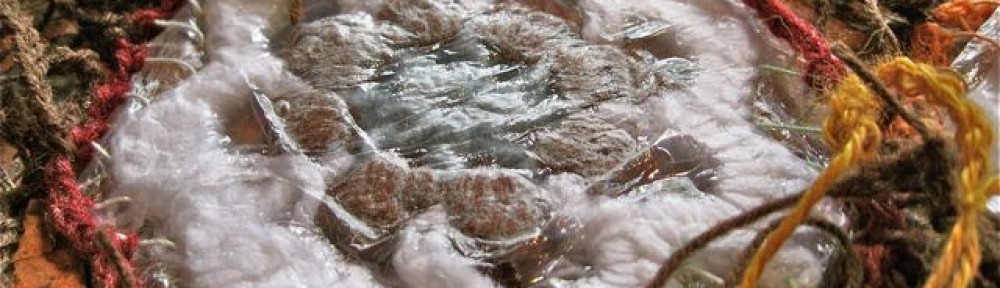
Silvia Piza-Tandlich: Molecular Composition. Recycled afghan, fused plastic, papel picado, crochet. 2011, Salon For Recyclability In Textile Art, Oaxaca. Photo: Martha Alvarez.

Aside from the obvious thrill of chatting with artists and meeting new people, Oaxaca will feature Carolyn Kallenborn’s premiere of her documentary, Woven Lives, at the Oaxaca Textile Museum on June 2nd, which I really wanted to see.

Unfortunately, making the trip from Costa Rica to Mexico is expensive, and as my husband’s voice of reason sadly tells me what I already know, he also proposes to find “ways to fill the void.”  He’s right!

DVD cover for Woven Lives

While nothing could fill the void of not attending our own exhibit’s inauguration, so it happens that Carolyn Kallenborn does have the film on DVD for sale, and I have already requested a copy.

It also occurs to me that Carolyn has to fly herself all the way to Oaxaca at whatever price airlines charge, and then fly to the SDA Conference where she’s also giving a lecture and showing the film. I therefore, urge everyone to buy the film, and I know we won’t regret it: It’s made in very good taste, contains a lot of valuable information, and the proceeds will help Carolyn continue this type of important research. Last week I posted the film’s trailer, and I’ve seen photographs of Carolyn’s life with this Zapotec textile community in Oaxaca. This film is must-see, must-have! You can go to her website and use the payment options available

Or you can go to Oaxaca and see the exhibits at the Casa de Arte de San Agustín (CaSa) as well as the Oaxaca Textile Museum film premiere. If you go, please take lots of photos and share them with me!

—Silvia Piza-Tandlich

6th WTA Biennial: Documentary in Oaxaca, Mexico

Woven Lives is Carolyn Kallenborn’s documentary to be shown on June 2nd at the Textile Museum of Oaxaca as part of the 6th WTA International Textile Biennial. The weavers who are in it will be seeing it for the first time, which will prove to be a very special moment for them.

Carolyn spent a considerable amount of time in Oaxaca working with these weavers, and has recently finished this wonderful documentary.

I was lucky to attend her witty and fascinating lecture last September at the Costa Rican-North American Cultural Center, where she talked about some of her experiences getting acquainted in Oaxaca, and showed photographs of her community work, as well as the video below.

After the Oaxaca premiere, Carolyn will be showing the film on June 10th at the SDA Conference in Minneapolis.

—Silvia Piza-Tandlich, translation

Greetings from Grace!

Grace Kawall, Myth&Religion, quilted painting

Grace Kawall at work

Grace Kawall is a multi-talented Brazilean textile artist living in Ubatuba, from where she spreads cheer around the world. She has had over 40 exhibits in the U.S. and other countries.

Her enthusiasm and intensity are contagious not only in her exuberant textile paintings—which she hand quilts—but in her beautiful home and landscape as well.

She will be visiting NYC soon, but in the meantime she sends the customary “big hug” (typical LatinAmerican style greeting), to all of us.

Um grande abraço, Grace!

Grace's works at Café Piu Piu in São Paulo

You can see more of Grace’s works in video form: www.youtube.com/watch?v=HZCuUa5aFuE

and at Grace’s site: http://ceciliakawall.ifp3.com/2/a5975

—Silvia Piza-Tandlich

Carolyn Kallenborn films Mexican textile community life

Woven Lives: Contemporary Textiles from Ancient Oaxacan Traditions examines how traditional art and design play an active role in the cultural sustainability of the Zapotec communities in Oaxaca. This documentary, which traces the development of the weaving process from the first people in the valley to the present day, uniquely blends the perspectives of art, design, business, history, ethnic studies and cultural anthropology. While the textiles are the centerpiece of the film, it highlights the life around the production that creates a sense of connection to the culture, the community, the past and the future.

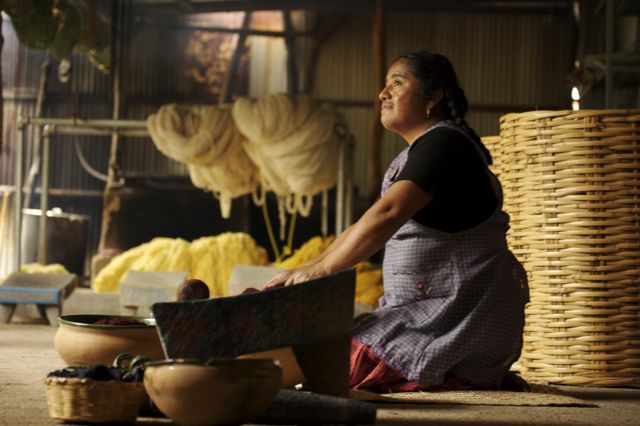
Textile creator in Oaxaca, Mexico.

The weaver’s work is filled with color and textures from dyes and yarns. The meditative movement of the spinning wheel and swift work of the weaver’s expert hands show a rhythm of motion at the loom that has been going on without interruption for centuries. The workroom is filled with the clack of the looms, the noise of the chickens in the yard, and the voices of the weavers as they speak with pride of their work. Photos can capture an instant. Written words can describe the scene and pass on tremendous amounts of information, but only through movement, color and sound can one really communicate the experience of the process, their connection to their culture and the beauty of their extraordinary textiles.

Visit the website
Documentary Film by Carolyn Kallenborn

6th International CIPED Congress in Portugal

6th International Congress on Research & Design

Evelise Ruthschilling from Brazil (SDA member since 1989), has been busy preparing for the 6th International Congress on Design & Research, Portugal.

Evelise teaches Art & Design at the Federal University of Rio Grande do Sul (UFRGS). You can see Evelise’s textile work by visiting her site at   www.contextura.art.br

A Second Call for Papers is now open until May 8th, 2011.

After receiving numerous requests to extend the deadline for article submission to the 6th CIPED, the organizing committee has decided to extend this deadline to May 8, 2011.

This Congress will take place on October 10 – 12, 2011 at the
Fundação Calouste Gulbenkian Foundation in Lisbon, Portugal.

6th World Textile Art Biennial in Mexico

This Biennial will take place in the cities of Mexico DF, Veracruz, and Oaxaca. To learn more about this wonderful textile fiesta, visit the WTA website at  www.wta-online.org

Under the coordination of artist and professor Yosi Anaya, Ph.D., the biennial will offer an incredibly long list of exhibitions, conferences, workshops, and a textile congress sponsored by the University of Veracruz. Mexico is, after all, a very textile society with so much to offer.

Carolyn Kallenborn will show her documentary, “INTERWOVEN LIVES: CONTEMPORARY TEXTILES OF THE OLD OAXACAN TRADITIONS.” I can’t wait to see the entire film, which Carolyn introduced last September during the Redtextilia Encounter in Costa Rica.  She will lecture and show the film on June 2 at 8:00 pm at the Oaxaca Textile Museum.

—sdalatinREP                                                                                                                                                                                                                                                                                                                 

Good wishes to Alison Schwabe

Alison Schwabe

Dear Alison:

Our best wishes for a year of creativity and fun!

Alison had surgery last December, but she’s feeling inspired again.

Her SAQA quilt shown below—a contribution to the SAQA auction—usually marks the inspirational basis for Alison’s creative Series, and this year’s little piece is no exception: she already feels it fits in with the Timetracks series, which you can see by visiting her gallery at   http://www.alisonschwabe.com/gallery.php?cat=2

SAQA 2011 Auction piece

Alison is an Australian artist with extensive professional experience as a textile creator and teacher. She presently lives and works in Uruguay.

Her blog offers fascinating descriptions of her artistic process in developing each piece, or each series of pieces. For example, in her recent work, “Beachwork” she describes the mental process required to initiate work with purchased material she had previously deemed unsuitable.

"Beachwork", by Alison Schwabe. 2010

Unlike artists who prefer to work secretly until their work is ready for showing and viewing, Alison shares her mental and creative state with her public, thus allowing a better understanding of her creation.

"Circulation", by Alison Schwabe. 2011

To see more of Alison’s work, visit   www.alisonschwabe.com