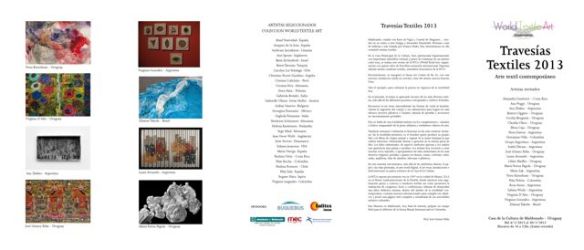
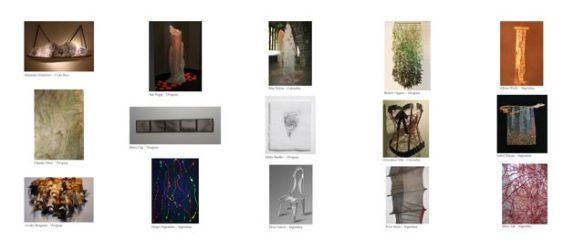
World Textile Art Organization (WTA) and the Maldonado Cultural House present
“Textile Journeys 2013”
January 4 – 30, 2013 4:00 pm to 10 pm – Closed Mondays
Venue: Maldonado Cultural House

—Silvia Piza-Tandlich
World Textile Art Organization (WTA) and the Maldonado Cultural House present
January 4 – 30, 2013 4:00 pm to 10 pm – Closed Mondays
Venue: Maldonado Cultural House
—Silvia Piza-Tandlich
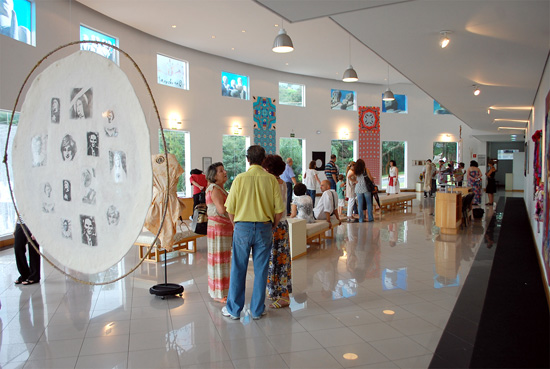
March 6 – 24, 2012
Tuesday through Saturday from 10:00am to 5:00pm
Victor Brecheret Convention Centre, São Paulo, Brazil
Curator: Zilamar Takeda
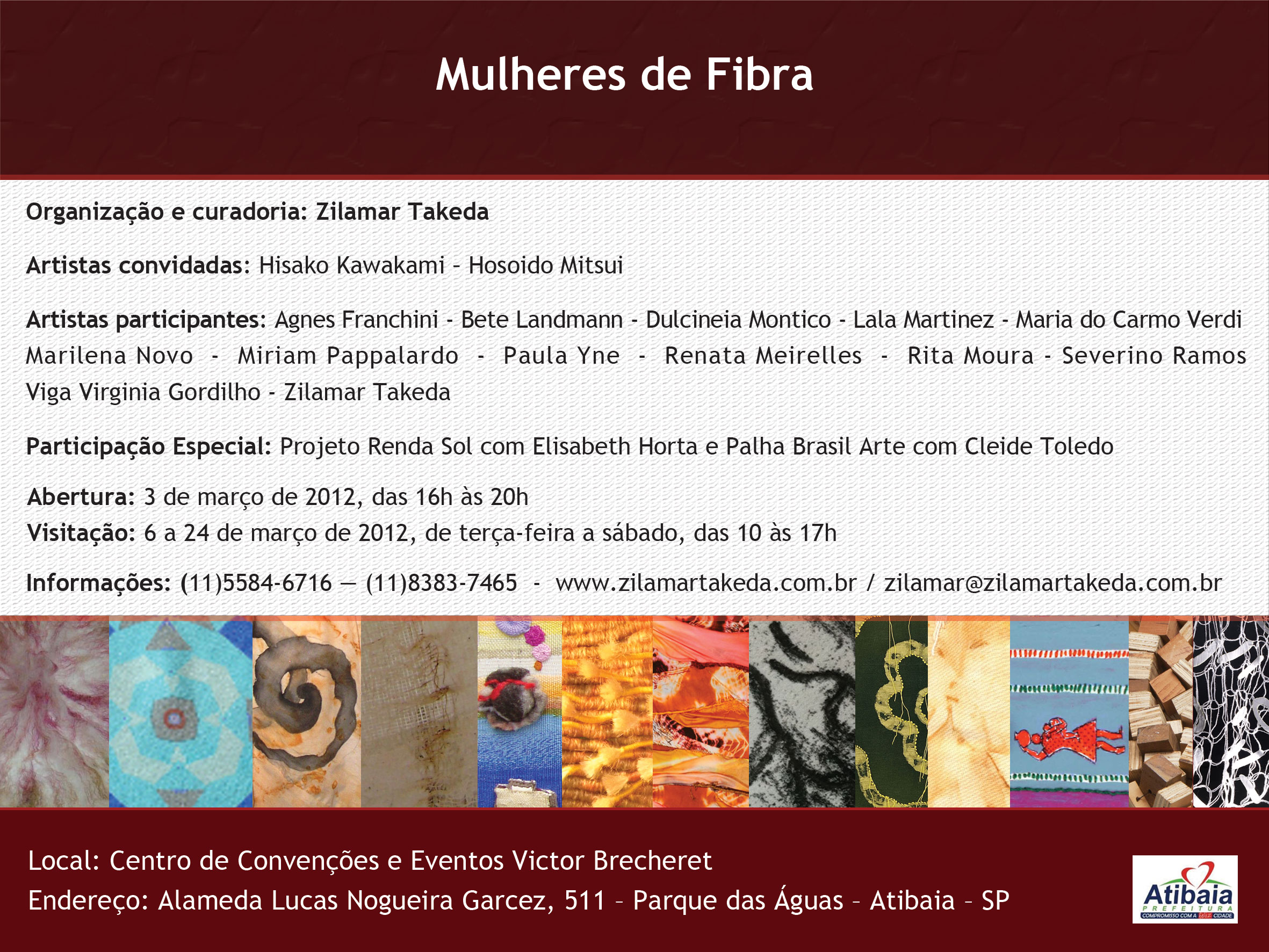
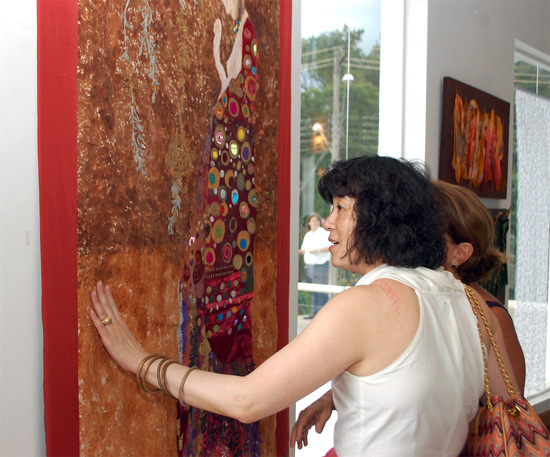
Participating artists: Agnes Franchini – Bete Landmann – Dulcineia Montico – Lala Martinez – Maria do Carmo Verdi – Marilena Novo – Miriam Pappalardo – Paula Yne – Renata Meirelles – Rita Moura – Severino Ramos – Viga Virginia Gordilho – Zilamar Takeda
Special guests: Renda Sol Project, with Elisabeth Horta & Palha Brasil Arte, and Cleide Toledo
Information: zilamar@zilamartakeda.com.br
—Silvia Piza-Tandlich, translation

 Calle Independencia & Plaza Manzana Uno
Santa Cruz de la Sierra, Bolivia
 Manzana 1 Espacio de Arte is a not-for-profit art gallery located in the historical center of downtown Santa Cruz de la Sierra, Bolivia. It is called Manzana 1 because it is found on the city’s first block. The building, which has been acknowledged as part of Santa Cruz’s historical legacy, was formerly the headquarters of the National Police and, after 13 years of neglect, it was opened once more, this time as a cultural space in 2005.

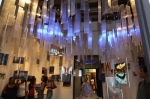
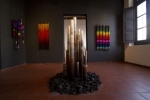
Beatriz Oggero is a Uruguay-born artist living in Cochabamba, Bolivia.
Contact Beatriz: www.beatrizoggero.blogspot.com
—Silvia Piza-Tandlich, translation
 Marianne Werkmeister’s “Window to the South” (Ventana al Sur) exhibition is being presented the entire month of February, 2012 at Hotel Termas Puyehue in the 10th region of Chile.
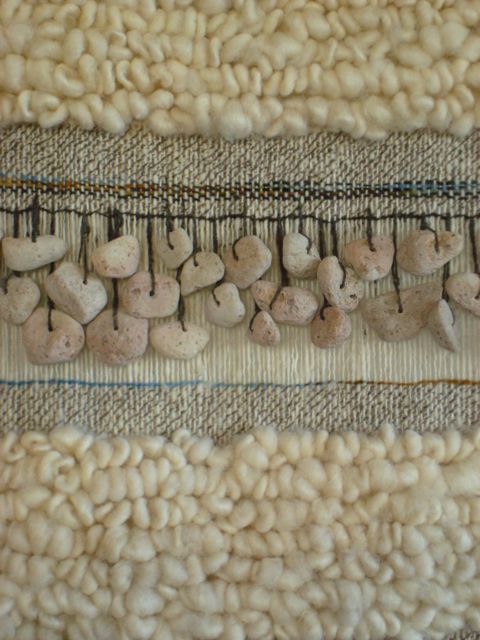
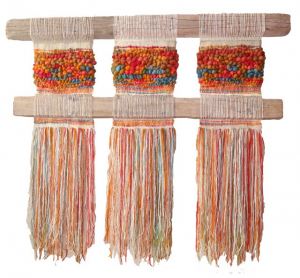
This new show is inspired by the wonderful landscape in neutral and grey hues, with pumice stones from the Caulle volcanic range, and very thick yarns.
The following work is from the “Stone Sea” series, followed by one of “Ventana al Sur” pieces.
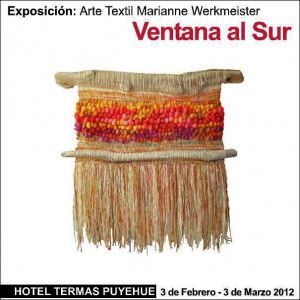
Marianne Werkmeister, Textile Design
http://artetextilmarianne.blogspot.com
Termas Puyehue Hotel is located in the 10th region of Los Lagos at the foot of the Andes. It overlooks the impressive Puyehue National Park: a Nature sanctuary embracing 107000 hectares of beautiful forests, rivers and lakes, which was declared UNESCO’s biosphere reserve.
Address: Puyehue Ruta 215, Km 76 | Osorno, Puyehue 64, Chile
Pronunciation: Puyehue /poo-yeh-weh/
—Silvia Piza-Tandlich
Graciela es tejedora artística, nacida en Mendoza, Argentina. Su trabajo es una mezcla ecléctica del tapiz tradicional y su propio diseño contemporáneo.


Graciela Cicognani


Graciela Cicognani: "Depths"
Visit Graciela’s blog: www.tramadelsol.wordpress.com
E-mail: hilosytramas@gmail.com
Posted by: Silvia Piza-Tandlich
Dedicated to
Jorge Sosa Campiglia
Expositors:
Pablo Conde
Alejandra del Castillo
Nilda Echenique
Diego Masi
Sara Pacheco
Gustavo Real
Alicia Ubilla
A weft of friendships and brotherhoods
—Silvia Piza-Tandlich, translation
Faena Art Center: New Cultural Space In Buenos Aires
…a beast suspended within the landscape…
(These photos are not up-side down!)

 In September, 2011 Faena Arts Center opened its doors within the recycled neighborhood of Puerto Madero in Buenos Aires, Argentina. The majestic site could only open doors with an equally majestic textile bicho (beast) by the great Brazilean maestro Ernesto Neto, who suspended his crochet-based installation from ceilings and walls, and covered the nets with thousands of plastic balls.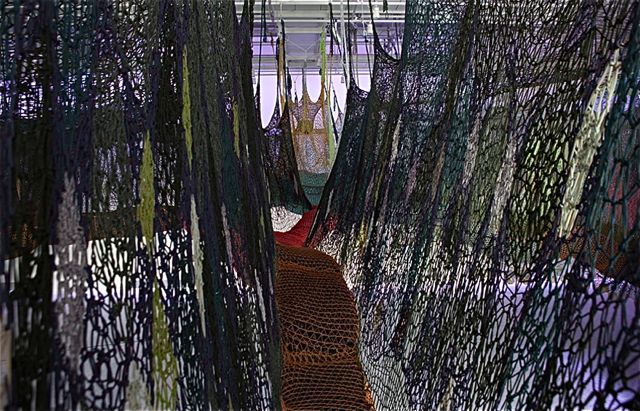
The result is this enormous organic form that seems to float above ground inviting visitors to walk, climb, touch and get lost in its insides.

Gabriela Nirino is swallowed by Neto's bicho
It took 30 assistants to help Neto create and install the beast.

Curated by Jessica Morgan, the exhibit is open to the public through February, 2012 and it’s a “must see, must feel” experience.
http://www.faenaartscenter.org/exhibition/11/ernesto-neto


—Silvia Piza-Tandlich
“HERBARIUM” EXPOSITION
at “El Sitio” – ANTIGUA-GUATEMALA
January 14 – March 8, 2012
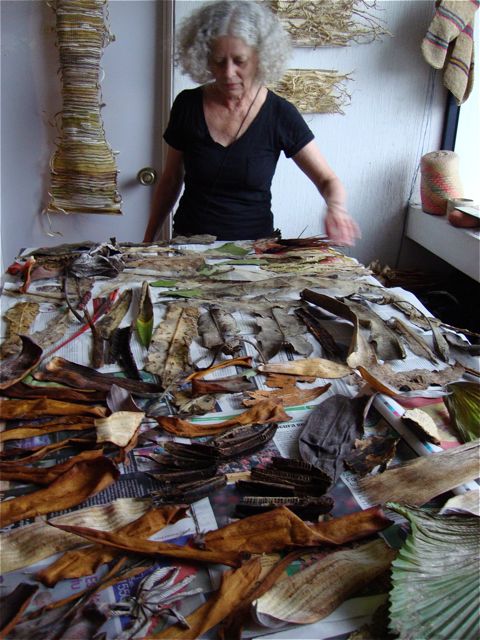 Marie-Noëlle Fontan’s prime materials are plants and their own forms and textures: roots, stems, pods and leaves, which maintain their form but not their order. This material is collected during Marie-Noëlle’s frequent travels.
Tangling, handling, spinning and weaving plants on her loom, she achieves her own form of landscaping to nourish our senses and imagination.
Marie-Noëlle’s work can be deemed as a return to the natural sources in textile art.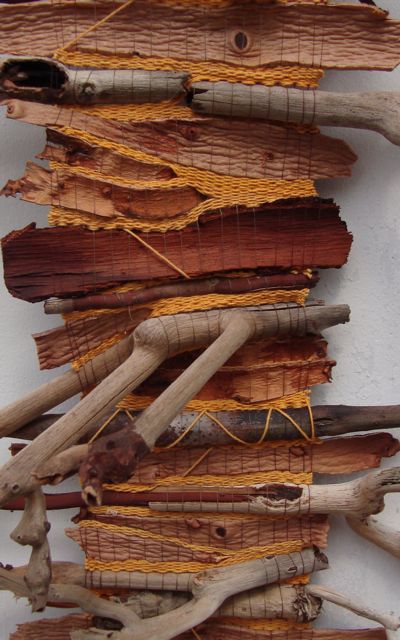
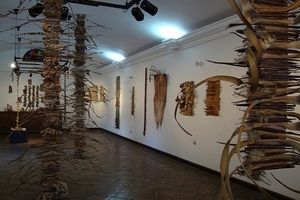 This week she inaugurated her exhibition “HERBARIO” in Guatemala, which will be open to the public until March 8.
Contact the artist: www.marie-noelle-fontan.com
—Silvia Piza-Tandlich, translation
 An interesting exposition named SAVIA (Spanish for “sap”) opened to the public last November 9 sponsored by the Simon I. Patiño Foundation, and presented at Kiosko Gallery. Curator Raquel Schwarz, with the inspiration of Hagamos el bosque (Make A Forest)—a Dutch organization dedicated to sustainable management of tropical forests (http://www.makeaforest.org)—selected 20 renown contemporary artists from Bolivia to present SAVIA through various artistic mediums.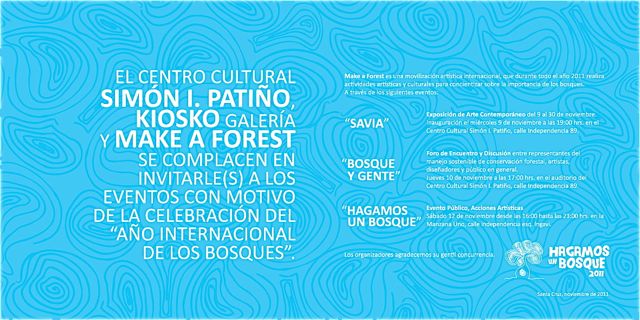
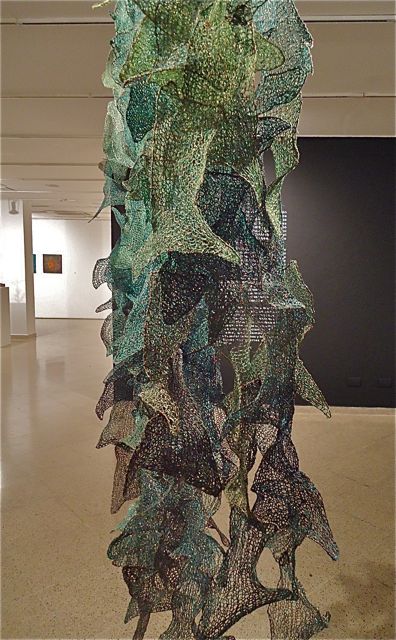 “Relicto” is a word to define remains of life organisms from the tertiary geologic Era —both vegetable and animal, which are scarce in the world: there are deposits in Chile, the Canary Islands, and Australia.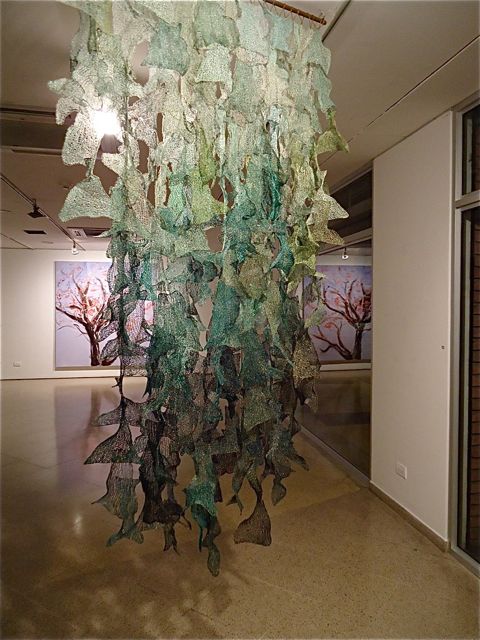
…”My idea when choosing this title, was that if we continue destroying the forest the way we have until now, there will only be these wonderful relicts left which, were we talking about human works, would be known as “relics”. While making the piece I thought that manual weaving in this contemporary world of digital looms, is also a relic of sorts, and that’s why I liked the term: I thought it was both strong and poetic…”
—translation by —Silvia Piza-Tandlich
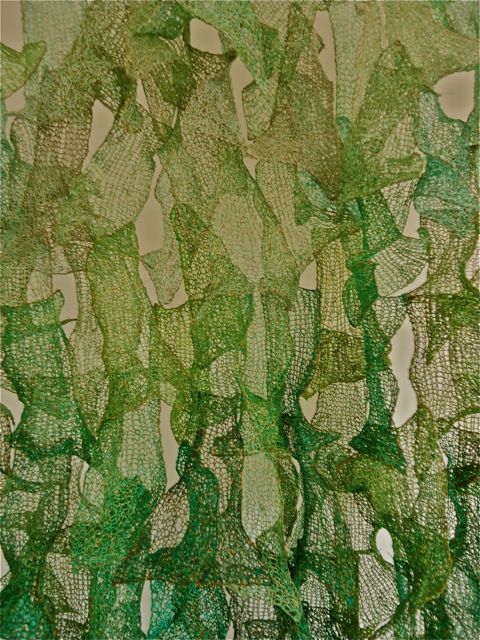
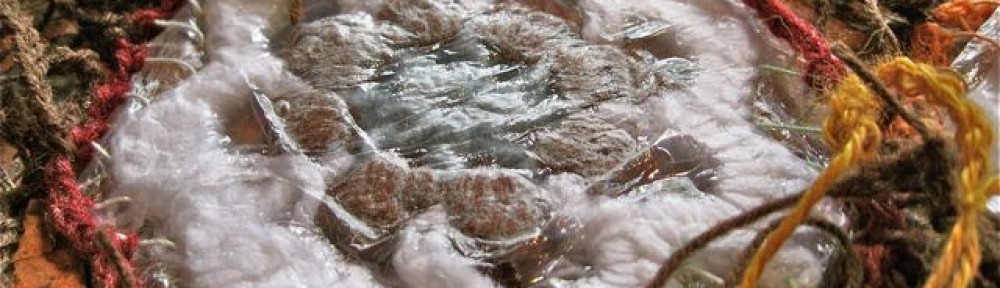
Beatriz Oggero: "Relict" - detail
 opustextile