
“Still In Time” in Łódź, Poland (at last!)

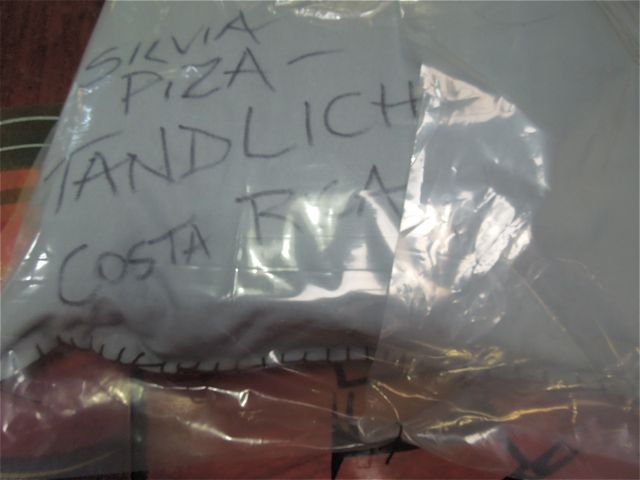
PackageIt has been quite a chore to send the package in since Costa Rica doesn’t adhere to the ATA Carnet For Temporary Admission (a requirement to send artworks to Poland). Thanks to prompt mediation work by the Polish Embassy’s Cultural Attaché in Mexico, however, I was given permission to send my work via courier. Therefore, once DHL actually delivers (it is three days late today), I will start making travel plans to attend this prestigious triennial’s inauguration ceremonies.
Announcement Silvia Piza-Tandlich. The following is my description of my work, which was sent to the Central Museum of Textiles:
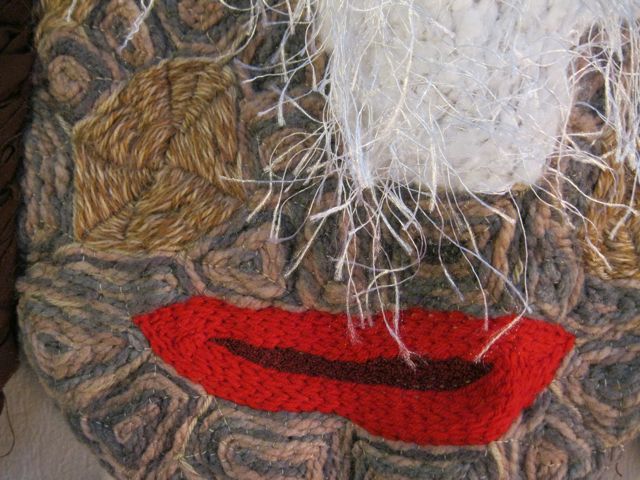
Still 9Lately, I have entered into my own life’s autumn just as the world seems to be in transition. I see myself, my mature husband, adult children, aching pets aching country aching world… all waiting for the best possible next scenario. In addition to the generalized feeling of confusion presently experienced by everyone on the planet, living in Latin America means being in a state of permanent financial crisis, yet surviving it and moving on. Nevertheless, today’s webs seem fixed in midair with turmoil underneath. Amazingly, however, this instability has turned out to be a second force guiding my inspiration.

I have developed appreciation and comfort in Indigenous creation. The expressions of Indigenous cultures are timeless, transparent, and seemly simple. As my personal life turns towards basic chores and pleasures, my artistic expression appears to flourish into a handmade mixture of Indigenous-based, contemporary elements conveying personal, political, and cultural yearnings into a visual element where past and present converge.
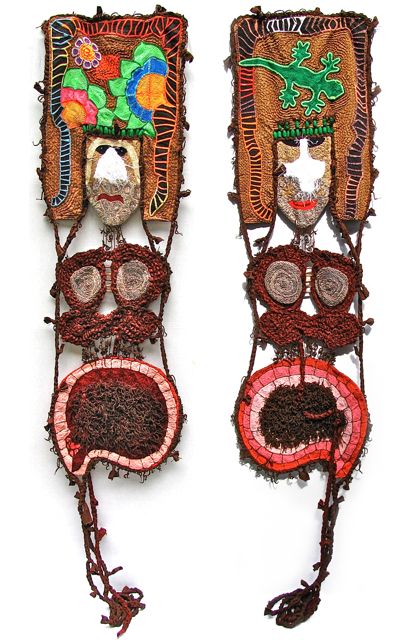
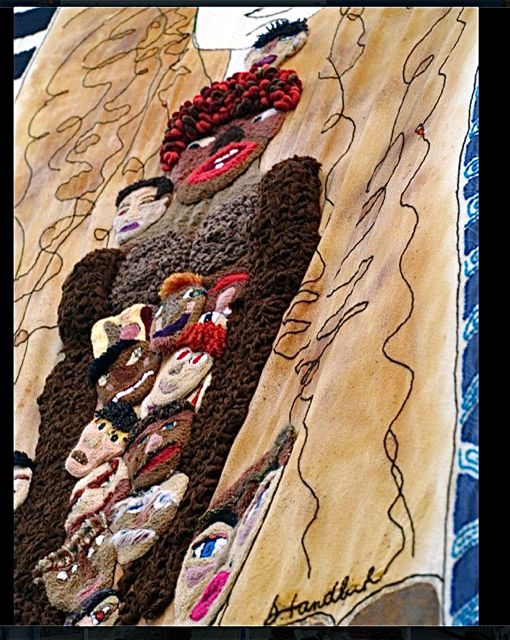
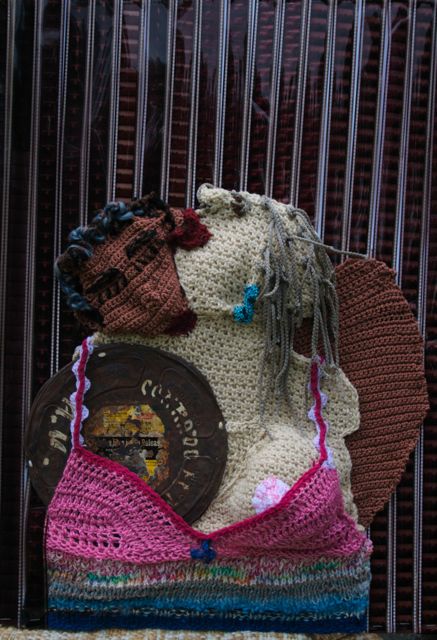
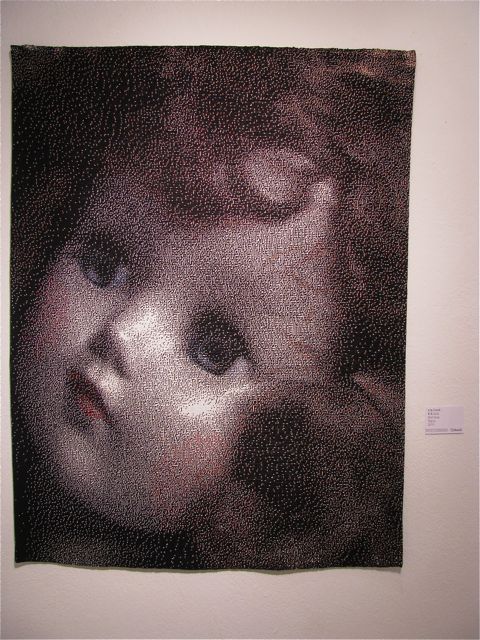
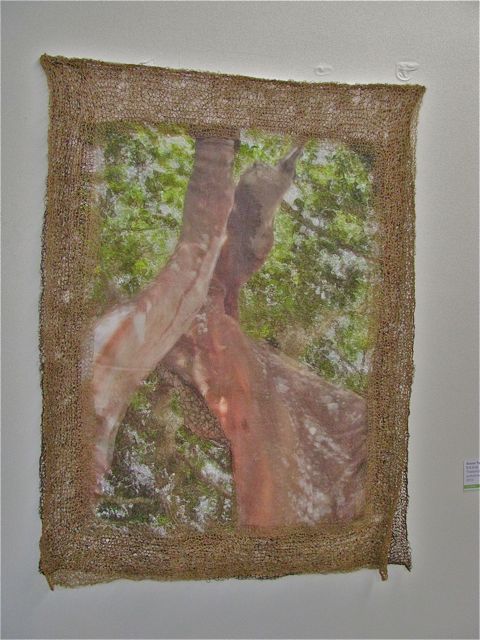
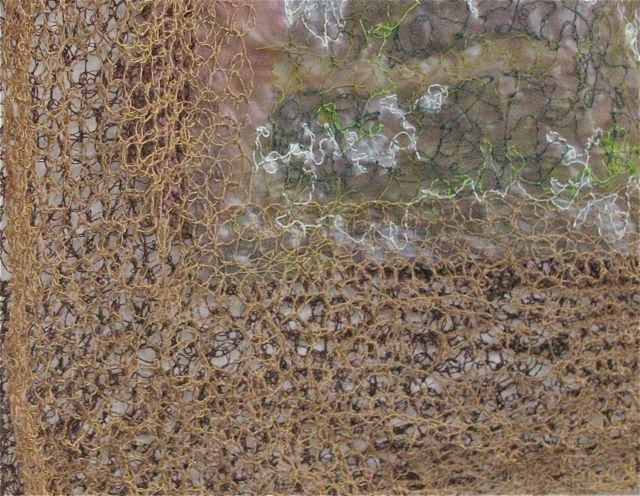
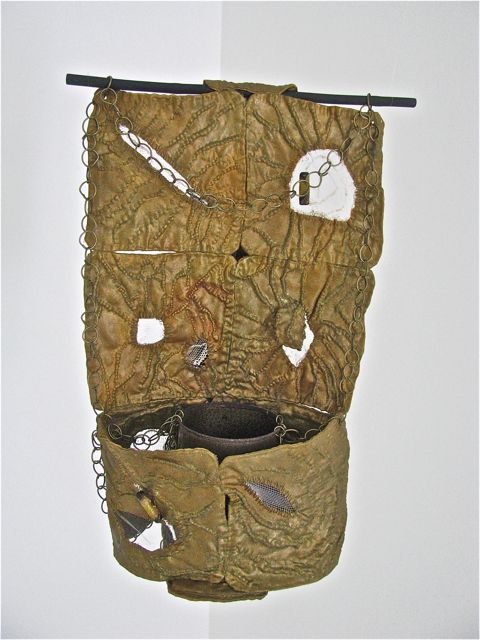
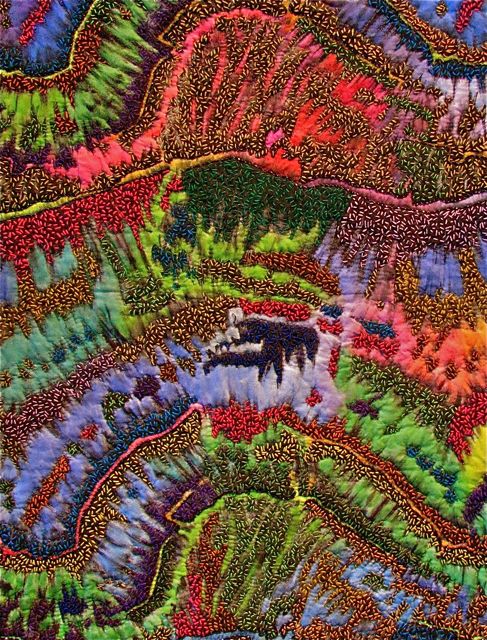
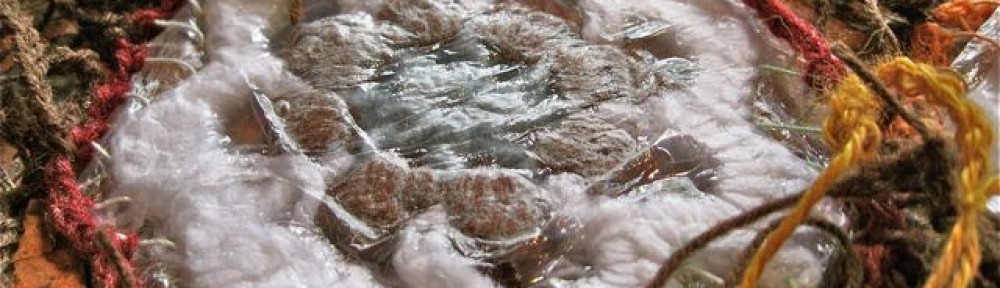
Piza-Tand Still in Time jpgMy work, “Still In Time” is a double-sided piece reflecting double-sided elements: past/present, naïveness/complication, modern materials applied with my own techniques, and traditional techniques used in innovating ways. Each side of the piece depicts an Indigenous mask, but there’s no telling which one represents the past or the present since both are sides of convergence.

It is my intention to reveal myself as a member of a world that tries to make us all similar, a cultural setting demanding us to be diverse, as well as an artist inspired by the environment and the times converging within me—shaping my identity, and making me unique.Still 2Still 1
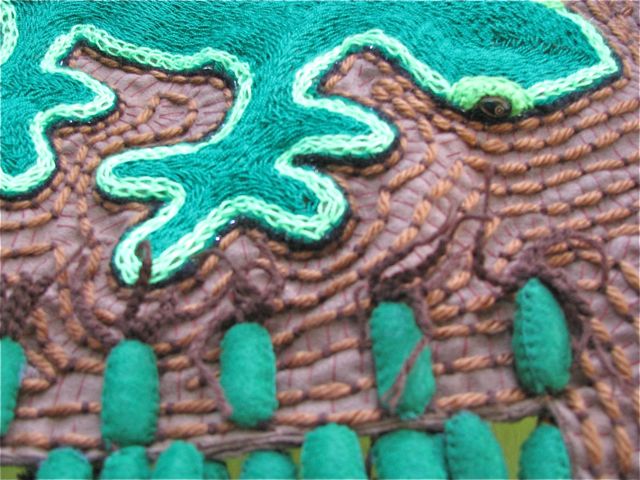
…”Recientemente, he entrado en el otoño de mi vida, justo en un momento en que el mundo entero parece estar en transición. Madura me veo a mí misma y a mi esposo, ambos con hijas adultas, mascotas dolientes país doliente mundo doliente: todos esperando el mejor próximo escenario posible. Además del sentimiento generalizado de confusión —el cual experimentamos todos en el planeta— la vida en Latinoamérica nos brinda un estado permanente de crisis financiera y, aun así, sobrevivimos y salimos adelante. Sin embargo, las redes de hoy día parecieran estar suspendidas en el aire, con tumulto por debajo. Creo que es increíble, por lo tanto, que esta inestabilidad resulte ser una fuerza secundaria que pueda guiar mi inspiración.Still 3
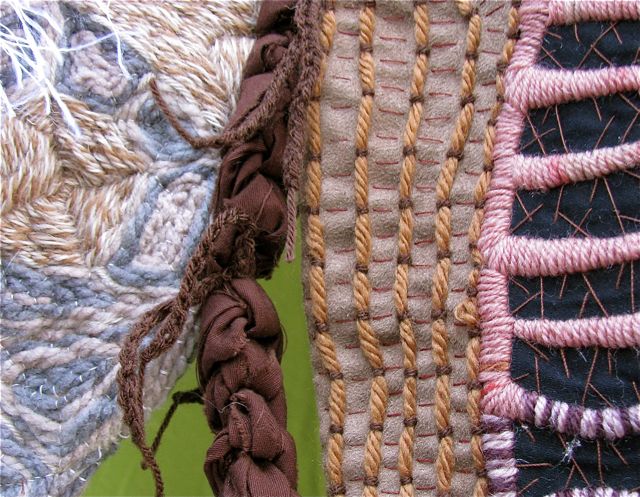
Me encanta la creación Indígena, la cual no tiene tiempo, pero sí es transparente y parece tan simple. Mientras mi vida básica se ocupa de quehaceres y placeres básicos, mi expresión artística parece renovarse con una mezcla hecha a mano, basada en lo indígeno: elementos contemporáneos representando lo personal, lo político y lo cultural dentro de mi elemento visual, donde el pasado y el presente, se juntan.Still 5
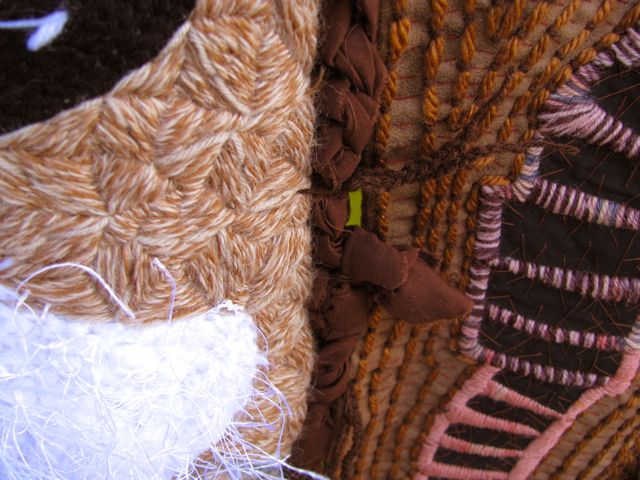
“Suspendidos en el tiempo” es una pieza de doble cara, con elementos de dos lados: pasado y presente; ingenuidad y complicación; materiales modernos aplicados con mis propias técnicas, y técnicas tradicionales usadas de manera innovadora. Cada lado representa una máscara indígena, pero no sabemos cuál es cuál, pues ambas convergen.
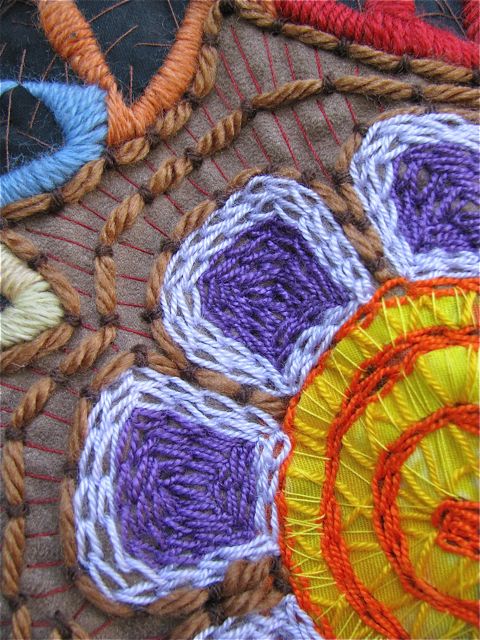
Still 7

Trato de revelarme como miembro de un mundo que nos quiere a todas homogéneas; un ambiente cultural que nos pide diversidad;  un mundo artístico propio inspirado por todo lo que converge en mí misma, formando mi identidad y haciéndome única”…Still 13
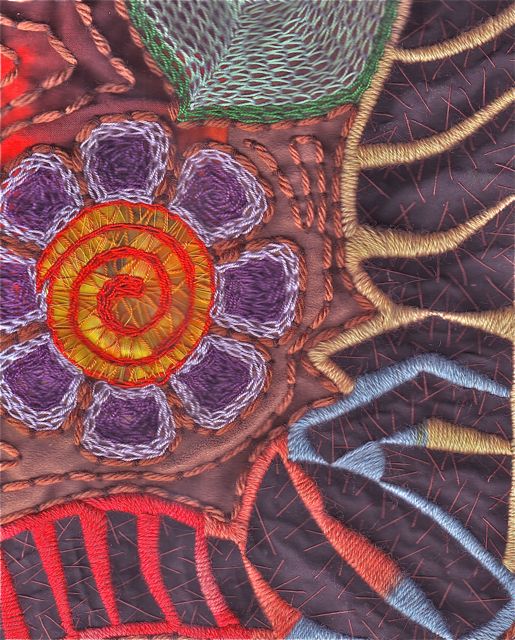
—Silvia Piza-Tandlich, October 2011, Costa Rica
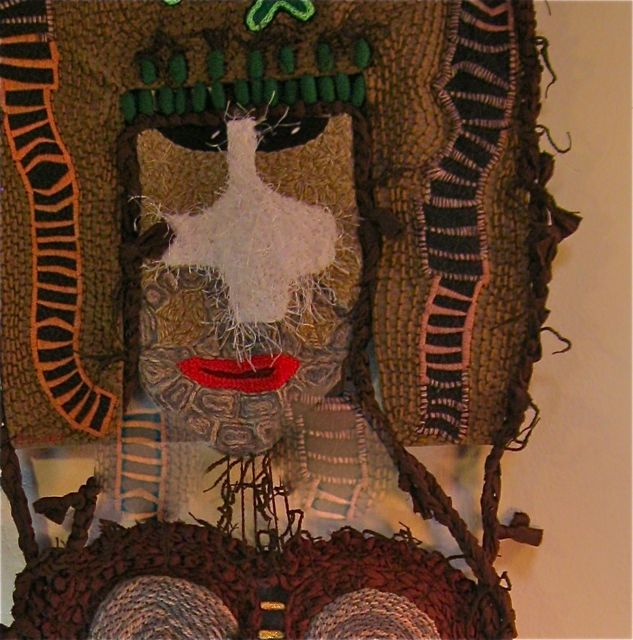
Still 12

After falling on the floor, the camera started to fail, but I actually like this effect!


14th International Triennial of Tapestry, Łodź, Poland/POLONIA

I have been invited to participate the 14th International Triennial of Tapestry in Łodź, Poland. The exhibition/competition will be at the Central Museum of Textiles from May 6th to Nov. 3, 2013. I am honored by this opportunity, and look forward to the event. The Łodź Triennial was first held in 1972: it is the oldest and largest specialized exhibition in the world.

http://www.muzeumwlokiennictwa.pl/aktualna-edycja/

He sido invitada a participar en la XIV Trienal Internacional de Tapicería de Łodź (Polonia). Esta exhibición/competencia se llevará a cabo en el Museo Central de Textiles, del 6 de mayo al 3 de noviembre de 2013. Me siento muy honrada por esta oportunidad y espero ansiosa este evento. La Trienal de Łodź se inició en el año 1972: es la exhibición especializada más antigua y más grande del mundo. —Silvia Piza-Tandlich

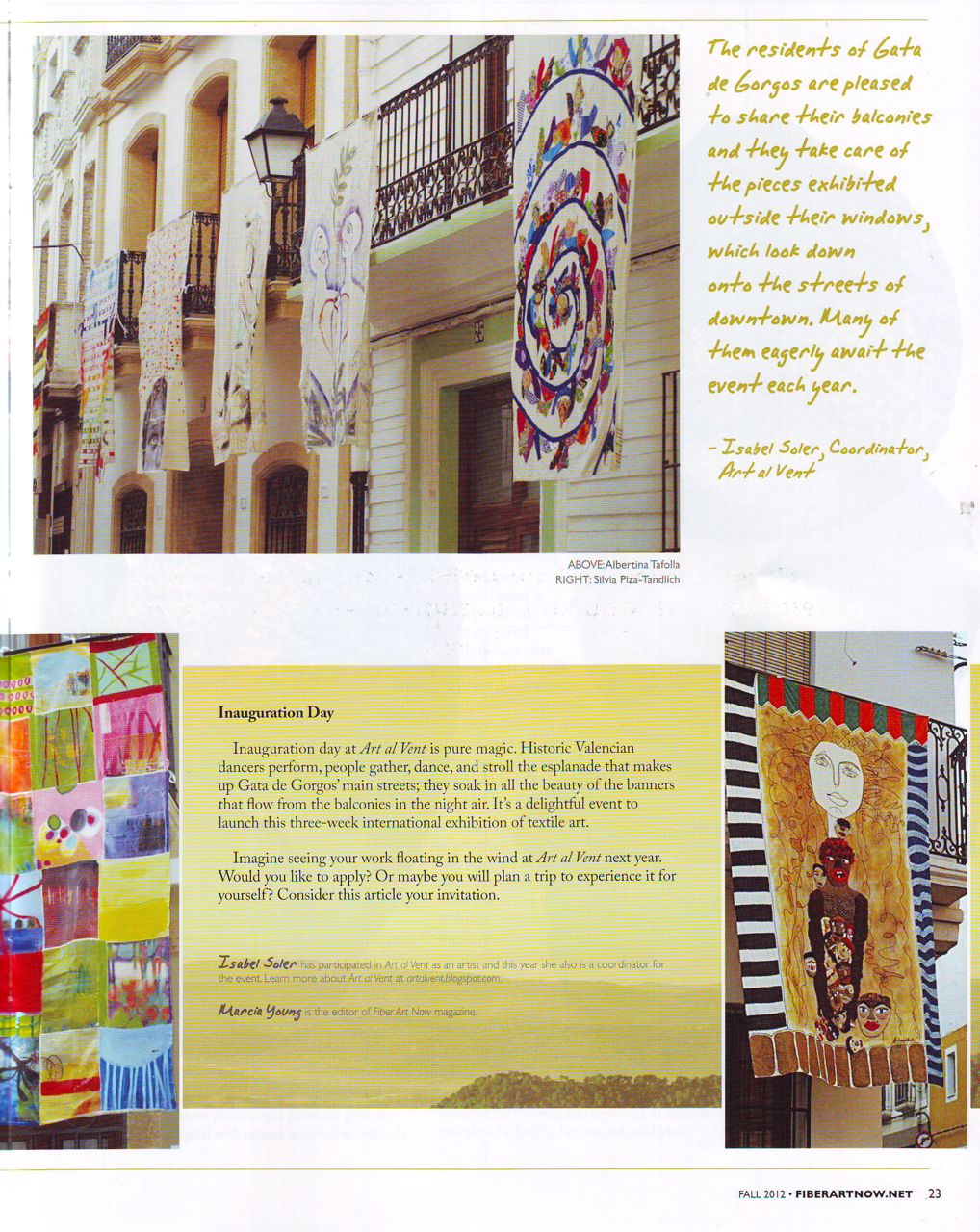
9th Art Al Vent


I’m working on my 2.5meters/by/1.63cm piece. It’s huge!!!
Trabajo en mi manta, que mide 2.5 X 1.63m. ¡Es enoooooorme!

El 1 de agosto a las 20h. se inaugura en el Casal de la Música de Gata de Gorgos una muestra restropectiva de balconadas. La muestra permanecerá abierta hasta el 9 de setiembre de miércoles a domingo de 19 a 21h.
Os esperamos.

L’1 d’agost a les 20h. s’inaugura en el Casal de la Música de Gata de Gorgos una mostra restropectiva de balconades: romandrà oberta fins al 9 de setembre de dimecres a diumenge de 19 a 21h. Us esperem.

August 1st is the inauguration of a retro exhibit of balcony works at Casal de la Música in Gata de Gorgos, Spain. The show will be open to the public until Sept. 9 from Wed. through Sun. 7:00 to 9:00pm. See you there!

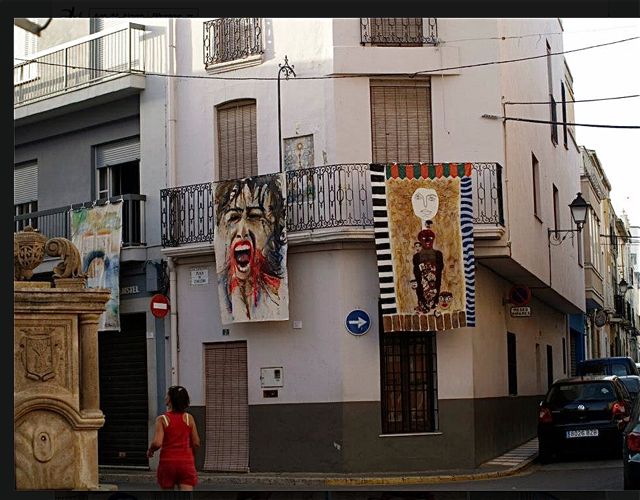
17 August, 2012: Gata de Gorgos, Alicante, Spain (España).

Esta tradición va a ser itinerante a Holanda.

This tradition has become itinerant: from Spain it will travel to Holland.

artalvent.blogspot.com


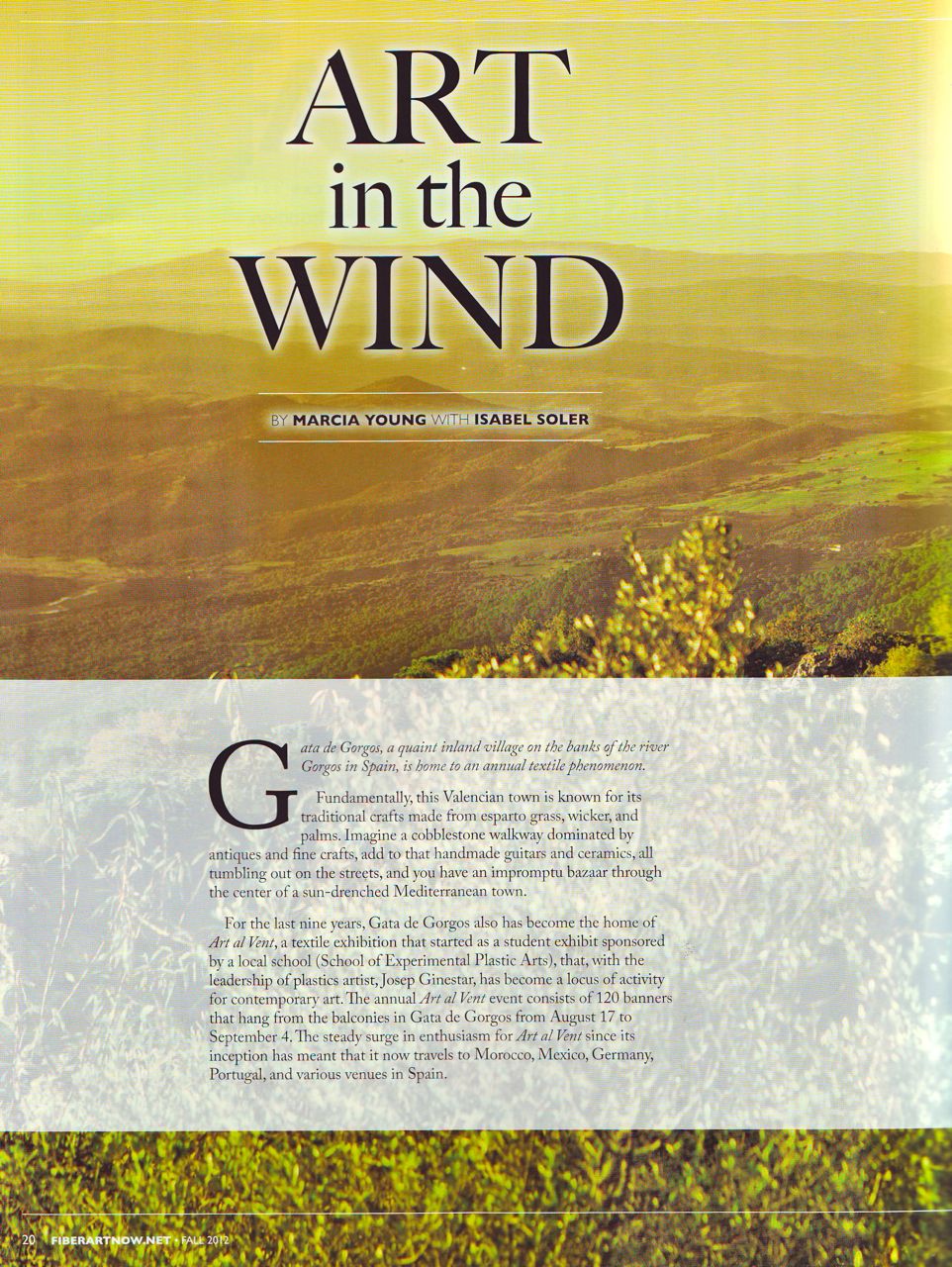
Article in Fiber Art Now magazine, Fall 2012 issue.

Artículo en la edición de otoño 2012 de la revista Fiber Art Now:

http://fiberartnow.net/


—Silvia Piza-Tandlich

Wooden Knife Troubadour Takes To the Alley On Sunday – CUCHILLO ‘E’PALO EN EL CALLEJON

ALAJUELA, COSTA RICA:

Many artists (myself included) feel they must use their visual message to get closer to the people and of course, art must have social projection. Pristine walls to show our work don’t always let us reach everyone, not to mention the fact that often times our political message isn’t compatible with fancy places that could be intimidating to some people.

Algunos artistas, de los cuales no soy excepción, creen en su deber de hacer entrega de su mensaje visual de una manera más cercana a la gente y, por supuesto, su arte debe tener proyección social. Las paredes elegantes para exposición no siempre le llegan al público y nuestro mensaje político no es compatible con lugares elegantes, los cuales a veces más bien intimidan.

Therefore, it is safe to say that our identity is anchored by the way we project—and to whom, and in the case of Carlos Vargas Olivares, where.

Nuestra identidad está anclada en la manera en que proyectemos, y a quién, y en el caso de Carlos Vargas Olivares, dónde lo hagamos. 

How: Carlos tickles and plays and pokes until he provokes what he refers to as, “our honest spot within ourselves,” making us recognize at least some of the multiple messages in his work. He wants to recycle, and help in the integration of bamboo structures as a green renewable material: presently he is searching for ways to include Costa Rican cabuya (sisal) braiding in the knotting of intersections of modular bamboo pieces, with the intention to create sustainable design alternatives.

Cómo: Carlos juguetea y provoca lo que describe como “el botón honesto dentro de nosotros”, para que reconozcamos algunos de los mensajes de su obra. El recicla y ayuda en la integración de estructuras de bambú como material orgánico renovable: actualmente explora maneras de incluir cabuya trenzada de Costa Rica en las intersecciones de piezas modulares de bambú, con intención de crear diseños alternativos sostenibles.

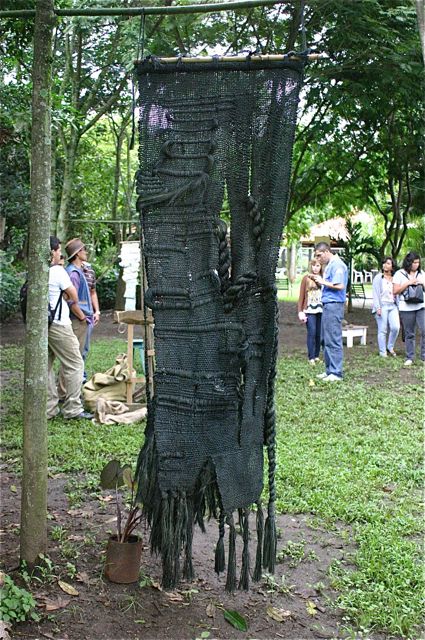
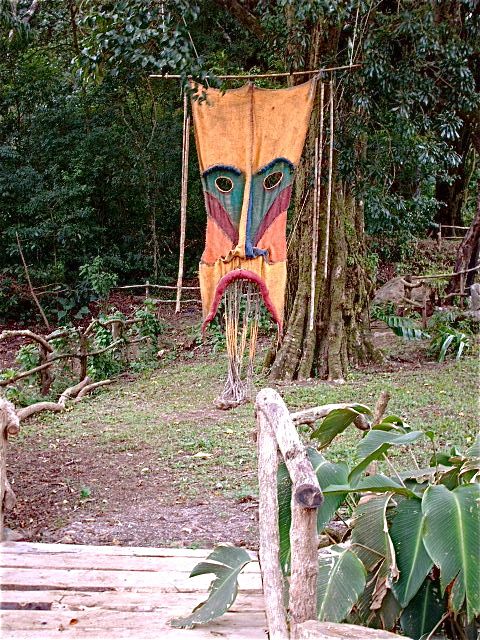
To Whom, and Where: To anyone who gets lured into his concept of “chunche” corner (chunche is Costa Rican slang for whatchamacallit), out there on a public park in the province of Alajuela, Costa Rica, where he’s been taking his Sunday installations for the past year. The motive is to show recycling within sisal knits, and trigger questions which trigger chats and awareness. Sisal has a wonderful aroma, and Carlos (aka Cuchillo’e Palo, or “Wooden Knife” in English), adds it to the entire sensorial setting in order to evoke time, space, and smell. He is, indeed, a weapon of art projection!

Para Quiénes, y Dónde: Para quienes se acerquen a su concepto de “esquina de chunches” (chunche es la palabra costarricense para definir cualquier cosa de la que no recordemos su nombre), allí por el parque de Alajuela en Costa Rica, en el pasaje donde ha venido llevando sus instalaciones los domingos, por un año. El motivo es mostrar sus tejidos en cabuya y provocar preguntas que provoquen tertulia y conocimiento. La cabuya tiene un delicioso aroma y Carlos, conocido como Cuchillo’e’Palo, usa ese aroma como parte de todo el conjunto sensorial, para evocar tiempo, espacio y olor. El es, sin duda, una arma de proyección artística.What: Jack-of-all-textile trades, and when it comes to style Carlos has coined his own label, which translates to “junk/object” although he’s also interested in experimentation, murals, mixed-media textiles, and ceramics.

Qué: Hombre banda y cuando se trata de estilo, Carlos ha creado su propia etiqueta: “chunche objeto”, aunque también trabaja en experimentación, murales, textil de técnica combinada y cerámica. 

Contact: http://www.carlosvargasolivares.blogspot.com

—Silvia Piza-Tandlich
Notice: Carlos suffered a great fall from one of his structures recently, and it is my wish that he recovers soon and gets back to his alley!
Nota: Recientemente, Carlos sufrió una gran caída de una de sus estructuras y espero que se recupere y vuelva a hacer presencia en su callejón.

11th ART INTER/NATIONAL COMPETITION

SDA members Silvia Piza-Tandlich (Costa Rica), and Irina Dorofeeva (Russia) have been selected to exhibit in this year’s 11th Art Inter/National competition. These two selections are the only textiles pieces chosen from over 500 proposals from all over the world in all artistic mediums.

Nicole Cappozi, owner and director of BoxHeart Gallery, explains: “The basis for an invitation to participate in The Art Inter/National Exhibition is sensitive to the diversity of work submitted; Box Heart strives to recognize that artists make art for different reasons and from different experiences. Box Heart looks closely for works that convey evidence of personal creative explorations and artistic commitment that directly relate to the purpose of the exhibition. A large part of determining the artist’s commitment to the exhibition’s theme rests solely on their ability to convey this evidence through the artist statement. The execution of the art work – as related to the artist’s intention – is then considered. Over 500 entries, from regional, national, and international artists, were received this year. Of these entries, 20 artists were selected for participation and 25 works of art in a variety of media will be exhibited.

With an ability to see scenes as a collection of lines, shadows, shapes, and contours, artists tend to see the world as it actually is. This form of seeing is the impetus behind all change. And when manifested into art, becomes the foundation for a scientifically informed account of the mind. The artwork selected for this year’s Art Inter/National Exhibition is unified by a wider appreciation for the many dimensions of uncertainty.” 

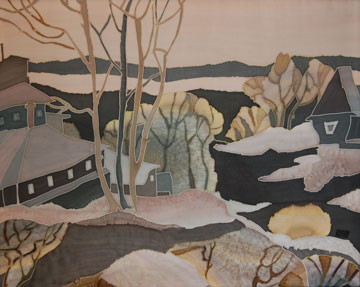
 Artist Irina Dorofeeva grew up in Russia and later moved to Indiana, USA. Often her silk works focus on nature and are inspired by landscapes, both Russian and American. She is touched by the remembrance of forests, fields, rivers, and small countries in Russia. But she is also inspired by the beautiful lakes, mountains, and shore lines in the U.S.. All these themes interconnect in her work and are the source of her art.

Silvia Piza-Tandlich is SDA Latin America/Caribbean area REP. Her handmade work, “Still In Time” is a point of convergence of past and present materials and techniques depicted in a double-sided Indigenous piece hanging from the ceiling.

The 60’s revisited and doing good social work

I arrived in Davis, California in 1976 and as it turns out, being too young in the 1960’s made me miss out on most of the hippie macramé curtains and tie-dyed shirts, although I still have the book, “Quilting, Patchwork, Appliqué, and Trapunto” by Thelma R. Newman, which I got for Christmas. Now in plain 21st century, I didn’t easily recognize a renaissance of the same campy elements and political thinking that characterized the 60’s, which might have to do with a change of era and its sociopolitical repercussions—just as it did back then. No need to remain hippie, however, because nowadays this artistic language goes by the label Decolonial Art since it emphasizes in questioning the so-called hegemonic culture.

—Silvia Piza-Tandlich

Alejandra Gutiérrez: Wonderbra.

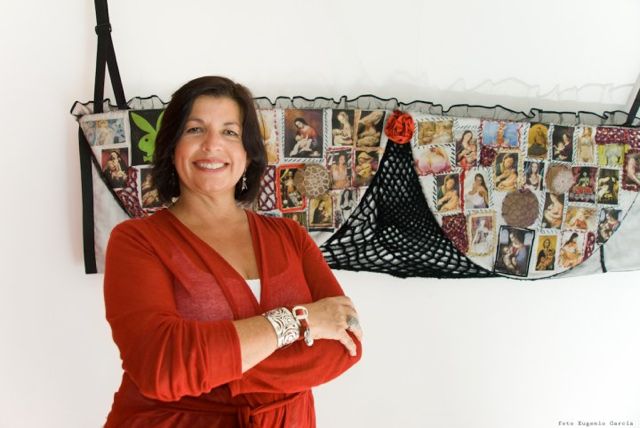
Last year I saw an article in the local paper about Costa Rican artist, Alejandra Gutiérrez winning Special Award at the 4th Latvia Triennial of Fiber and Textile Art, with a huge Wonderbra measuring 165 x 220cm (5.4 x 7 feet).  Her message was clearly political and clearly feminist in a Latin American world of macho dominance and social by-standards, and very fitting within other contexts throughout the world. From the textile point of view, however, what really caught my eye was the seemingly clumsy or bungled way of arranging otherwise fine elements…as if the piece was actually intended to convey two messages instead of one. It wasn’t until this week that I came to recognize the 1960’s style in Alejandra’s work, which can be camp, pop, “low” or whatever new twist may be resorted to in order to make her art transcend.

Alejandra in her studio, with "Catadupa Admirabilis" ("Splendid Waterfall") in the foreground.

Alejandra is very successful in creating a social structure through textiles, and dedicating her vast artistic creation to empower herself as well as the lives of other women around her. Her themes deal with the effects of gender disparity and social critique in today’s society. Curator Marcela Valdeavellano explains: …she strives to make art that asks us to reconsider the significance of both image and context, which may provide new understanding of how the two collide to shape our culture.”

“… MON 810 protests a species of transgenic corn, which belongs to the technology called Terminator, which causes transgenic seeds to become sterile. This property will radically alter traditional methods of agricultural production in benefit of corporations, in obvious detriment of our traditional agriculture where corn is a staple…”          

Alejandra Gutiérrez: Movie-Style Kiss. Mixed media textiles, 2009.

“… The society of show business has permeated our lives and now we no longer know what is true and what is Hollywood celluloid…” 

A Scholar at the International Textile and Apparel Association in California, USA, Alejandra is one of the two Latin American artists who were finalists in the above mentioned Latvia Triennial, being the only Central American who has earned this distinction.

In 2009, the Cajías Cultural Foundation in La Paz, Bolivia acquired her work MON 810, selected for the SIART Biennial of Art, Bolivia. On that same year she won the Acquisition Prize by the Helmspark Gallerie for her tapestry, in which she refers to the issue of breast cancer.

Alejandra Gutiérrez: Movie Star. Apparel Award by Fiberats Magazine/VISART, 2009.

In April 2010, Alejandra was also a finalist in the contest by the late Fiberarts Magazine and VISART Arts Center, Maryland, USA, “Wearable and Unwearable Art,” participating with an evening bag built with movie strips from the 1960’s, which she named “Movie Star”.

 Contact:
+506 2228-5522 atelier   –   +506 8882-2727 mobile
P.O Box 1525-1250, San José, Costa Rica
alegutierrezm@gmail.com
blog: tejolavida.wordpress.com
 

The following photographs were taken during the 6th WTA Biennial of Contemporary Textile Art in Mexico, where Alejandra participated as a lecturer:

Xalapa, Mexico, 6th WTA Biennial opening.

Sheila Hicks and Alejandra Gutiérrez in Mexico.

Sheila Hicks and Alejandra Gutiérrez, Mexico, 2011.


SELF-HELP ART

DELIVERY AS IMPORTANT AS CREATION:

“…We’re made of the same material, even though the form varies. We fear and desire the same, although each of us arranges it in a different order, same as we mold our sieve alter ego…”

As a contemporary textile creator, Ariane Garnier represents time and culture within the social structures that support and inspire her. Born in Costa Rica and educated as a visual artist, she resorts to a variety of techniques to deliver her message of self-help, growth, and transformation.

Since her first presentation 14 years ago, her discourse has evolved and has led her to develop the concept of joint self-help art, with human homogeneity as center stage. In her talented hands, the term social projection involves making art as well as studying each of the knots that trouble our modern self.

Ariane Garnier: Dress. Sieve, sewing and embellishments.

“We are made of the same material, but we only perceive that resemblance through the sieves of illusion. That’s the reason why we usually consider ourselves as individuals having a unique self, but that perception is made of an assortment of sieves we have set—one against the other—along history until we reach blindness.” 

The above tautological attitude is depicted by Ariane in her metallic threads—“seams and ties exposing our condition clearly.”

Ariane Garnier & Rafael Sáenz: Everyone With All. First prize piece at 4th WTA Biennial of Textile Art&Design, Costa Rica, 2006: "Man+Woman= Creation"

Among achievements is her First Prize at the 4th WTA Biennial in 2206.

Ariane Garnier & Perfect Feather, one of participants at Fuerteventura, Spain project.

She then built her first textile colloquium: Absence/Presence  through a performance/installation in mesh at the 7th Art Encounter in Genalguacil, Spain and, of course, her Women’s Forest project in Costa Rica was most interesting, where low-income peasants as well as higher-income city women designed and wore their own dresses.

Ariane Garnier: Art-Team Building project, Gran Canaria, Spain, 2007.

Ariane’s artistic expression weaves sieves made of several layers of metallic fabric. As “owner of her own Triumphs and Failures,” her social projection is, however, participative art that allows access and growth as a way to transform us.

Ariane Garnier: Women's Forest project participants, Turrialba, Costa Rica.

Together with partner-curator Marcela Valdeavellano, Ariane owns and directs La Zona Entrenarte (The Trainart Zone in English), a gallery/workshop space where they conduct frequent participative exhibitions and self-help artistic events.

I find it interesting that Ariane’s materials are cold and harsh, yet her human makeup is warm and meaningful. “In the end, we’re all the same; and if we’re creative, and if we’re aware, we’ll be able to build together instead of destroying separately…”

Ariane’s contact: http://www.arianegarnier.com     http://www.entrenarte.info     http://www.vimeo.com/user2718107/videos 

Ariane Garnier: Air Draft. Sieves and cords, shaped and sewn. 6th WTA Biennial of Contemporary Textile Art, Mexico, 2011.


—Silvia Piza-Tandlich

Jewelry with innovative materials and design

Gian Carlo Sandoval-Mazzero is a Costa Rican-born, Italy-educated architect and textile artist with a versatile mind, whose ability for design earned him the BID2010 AWARD for Costa Rica at the 2nd IberoAmerican Design Biennial 2010 in Madrid, Spain in Category, “Fashion, Textiles and Accessories.”

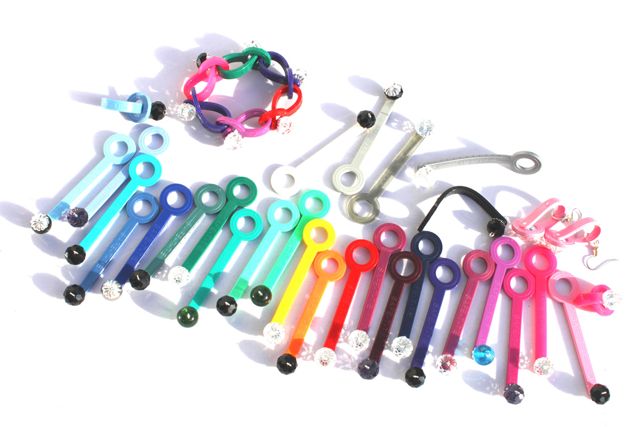
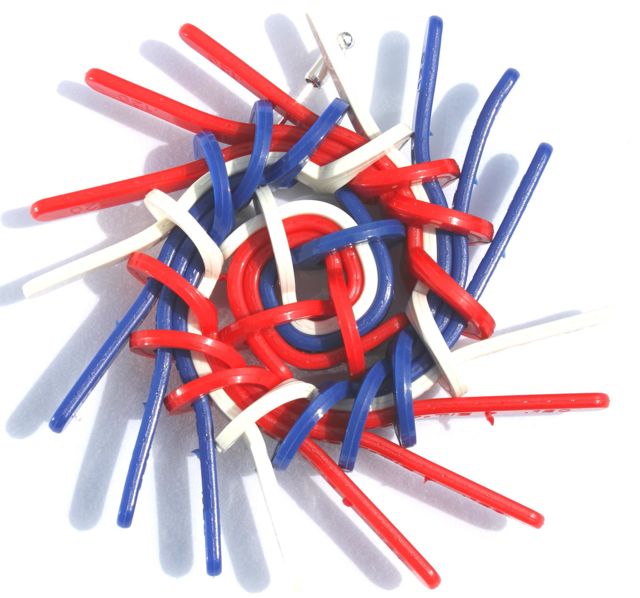
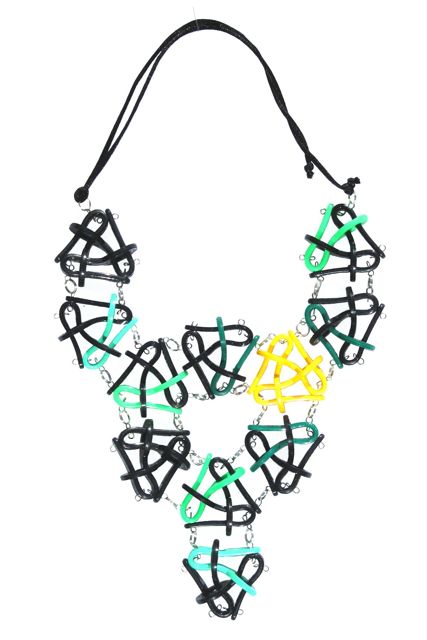
Information, observation and research led him to discover raw materials in unimaginable places: His Saturn collection is made with rescued orthodontic rubber, which he turns into very appealing jewelry.

Gian Carlo Sandoval-Mazzero- Saturn edition

Gian Carlo Sandoval-Mazzero: Necklace. Edition 150 of the Unitá d'Italia.

Saturn gives contemporary jewelry a new dimension: It honors the art of recycling/upcycling by turning discarded material into a design object.  Research on the product allowed Gian Carlo a deeper understanding of the characteristics of the rubber material that he uses.

Gian Carlo Sandoval-Mazzero: Bracelet. Saturno Galileo edition.

He discovered that the product has a particular Antimicrobial Technology With Silver, which prevents the growth of microbes. At the same time, it does not contain latex, it is resistant to wear and tear, and it comes in a wide range of colors.

Gian Carlo Sandoval-Mazzero: brooch. Saturno Stadium collection.

These
characteristics, in addition to the use of stainless steel, silver, crystal and glass, produce innovative hypoallergenic jewels.

Sandoval-Mazzero- Textilis Contemporaneous edition

Work presented by Gian Carlo Sandoval-Mazzero at the main competition of the REDTEXTILIA Encounter (IberoAmerican Textile Network), September, 2010 at the Costa Rican-North American Cultural Center.

More information:    http://gotikadesign.blogspot.com 

—Silvia Piza-Tandlich, translation

Encounter: Redtextilia

Encounter: IberoAmerican Textile Network (Redtextilia)

San José, Costa Rica – September, 2010

To view photos of the Encounter, visit    https://picasaweb.google.com/118006843679432349679

Irene Carlos, a Guatemalan artist working in textiles, mixed-media textiles, and television production, was a participant in the juried international Redtextilia Encounter’s competition: “Sustainable Tradition & Responsible Innovation”.

The exhibit took place at the Costa Rican-North American Cultural Center’s Wanamaker Gallery.

Below is a photograph of Irene’s work, with SDA member Lia Cook’s work in the background. Lia was a well-liked lecturer at the Encounter.

Work by Irene Carlos

Work by Lia Cook

Susan Taber-Avila, Carol Westfall, and Carolyn Kallenborn also offered very interesting lectures. Here’s Susan’s work at the Invited Artists’ Exhibit, Omar Dengo Foundation, Costa Rica:

Susan Taber-Avila, Omar Dengo Foundation exhibit, Costa Rica

detail, Susan Taber-Avilas work, Omar Dengo Foundation, Costa Rica

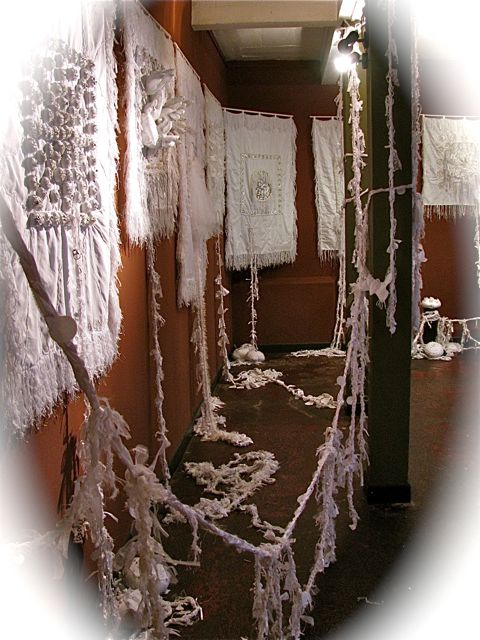
SDA LatinAmerican Rep Silvia Piza-Tandlich participated in four exhibits during the Encounter: The Affiliates’ Exhibit, Invited Artists’ Exhibit, Costa Rican Textile Creation Exhibit (at the Cartago Municipal Museum), and her own indoor intervention, “Metamorphosis: A New Cycle” at the National Museum.  www.galeriaoctagono.com     www.metamorfosishabitat.com

Silvia Piza-Tandlich, "Kaleidoscope", Omar Dengo Foundation, Costa Rica

Silvia’s piece on the left was chosen as background logo for the Encounter, which was the culmination of four years of association of artists of Latin America, Spain, and Portugal.

European Textile Network (ETN) President, Lala de Dios; Surface Design Association (SDA) President, Candace Edgerley; and IberoAmerican Textile Network (Redtextilia) President, Paulina Ortiz, formed a textile alliance during this Encounter in Costa Rica.

Silvia Piza-Tandlich, "Without Tobacco" Affiliates Exhibit, San José, Costa Rica

Silvia Piza-Tandlich, "Aurora", Cartago Municipal Museum

Silvia Piza-Tandlich, "Metamorphosis: A New Cycle." Fantasy intervention, 102 works within 11 spaces.


Visit the SDA Newsblog archive for November, 2010 to view SDA President Candace Edgerley’s article about the Encounter.

Carol Westfall during her conference.

Lia Cook and Rebecca Stevens (Textile Museum, Washington D.C.), give a lecture at Veritas University, Costa Rica

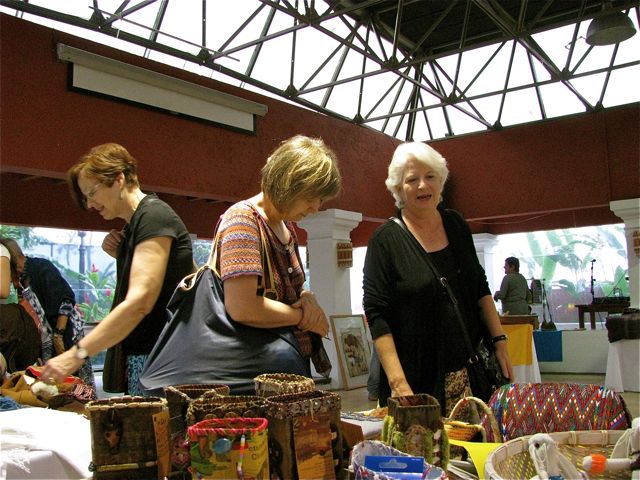
One of the Encounter’s most interesting activities was the Latin American Textile Fair, where many artists showed and sold crafts and materials from their own region, or their own creations.

SDA President Candace Edgerley, and members Joan Hutten and Ann Liddle at LatinAmerican Textile Fair, Mexico Cultural Institute, Costa Rica, September 19, 2010.

—Silvia Piza-Tandlich, translation