Argentine Center for Textile Art (CAAT) – Centro Argentino de Arte Textil

Textile Tourism: Argentine Center for Textile Art (CAAT)

Buenos Aires, Argentina: A city that goes to sleep at 6:00am and awakens by 3:00pm, at which time you can visit the Argentine Center for Textile Art (CAAT).

CAAT: Tramemos journal.

CAAT is a non-profit association that has been promoting textile creation for the past 34 years, encouraging its members to take advantage of monthly exhibition opportunities as well as conferences and workshops. It publishes the ever newsy and popular Tramemos journal*, and its vast textile library is considered one of the best in the world.

*“Let’s Weave” is a weak translation since the Spanish verb tramar means, “to plot” and “to warp” at the same time.

CONTACT:
Address Viamonte 1728 2º E (CP1055). Ciudad de Buenos Aires, Argentina
Phone (+54 11) 4371-7581
Website http://www.caat.org.ar
Hours Monday through Friday, 3:00 to 6:00pm
 

—Silvia Piza-Tandlich

ECO-WEAVING

Textile Tourism: ECO-WEAVING

It is easy to be attracted to the materials in the work of Uruguayan artist Silvia Umpiérrez, as if she had nothing to do in the making of her creative pieces.

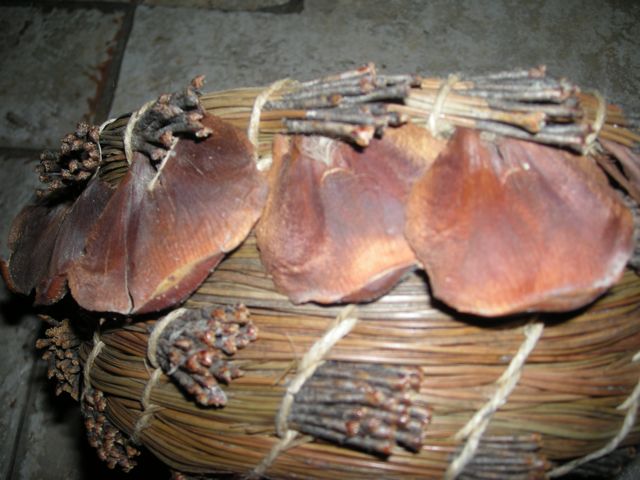
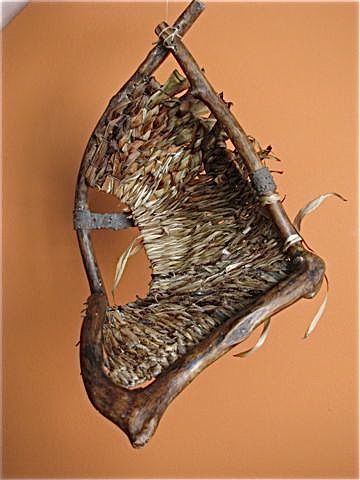
Silvia Umpiérrez: basket. Weaving with "pinocha" (pine needles), and other materials.

On the other hand, this unique work also shows a revaluation of the natural element normally thrown away or burnt, appearing to us in the life of something else. That can only be achieved through a thinking and creating process: Silvia’s own rhyme and reason is present at all times.

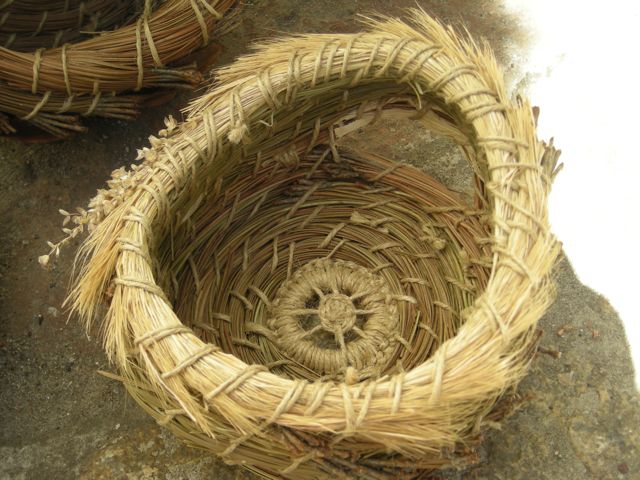
Silvia Umpiérrez: basket showing a Central American weaving technique. Pine needles.

She enjoys the sensorial beauty of dry nature—its colors and scents—which she normally works on a very simple, native loom used in the Uruguayan countryside to weave blankets and flounces, whose warp allows the incorporation of various materials.

…“I weave with my hands, placing each fiber, one by one. Same as life itself, I weft with transparencies and textures, respecting the natural colors of each material…”

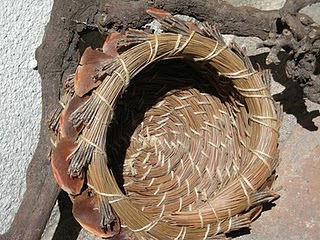
Silvia Umpiérrez: basket in Coulding technique.

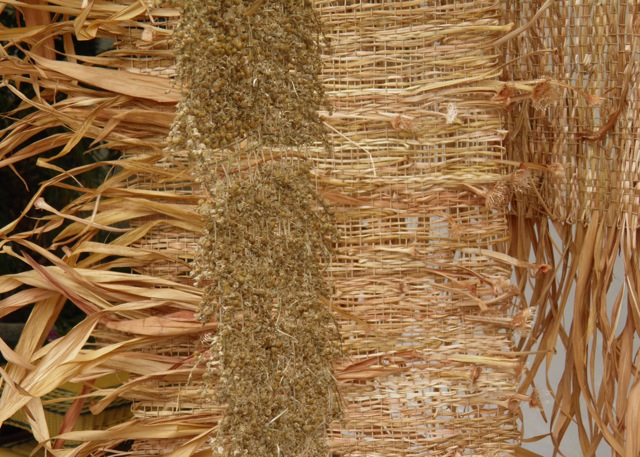
Silvia feels comfortable within this form of showing dry elements, including them in artistic work as well as utilitarian objects. She makes her tapestries by working with palm tree inflorescences, which give her a certain transparency. 

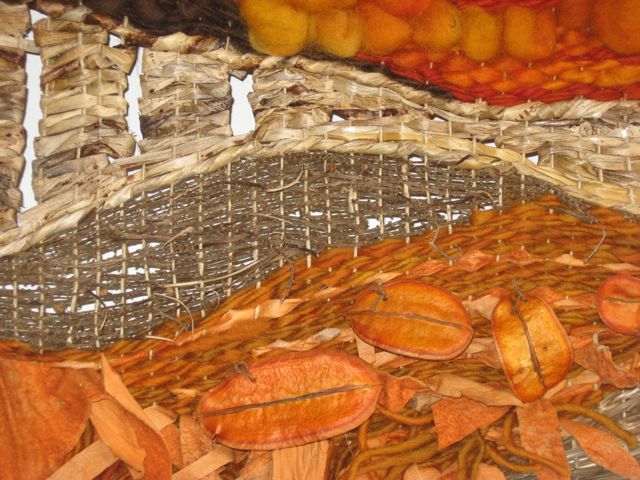
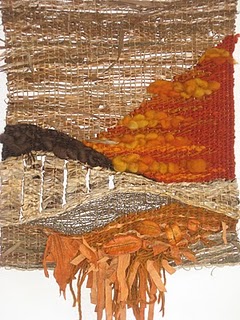
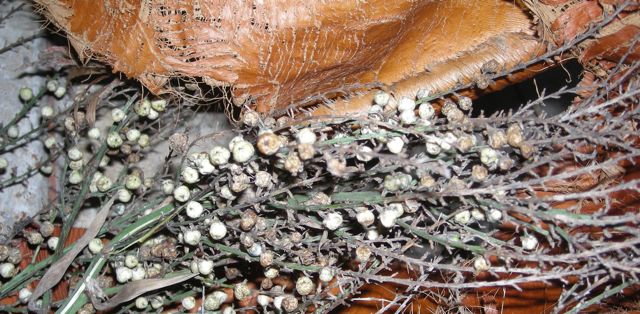
Silvia Umpiérrez: tapestry detail. Formio fiber (natural raffia-like leave, approx. 150cm. in length).

Tapestry by Silvia Umpiérrez. Some of the materials employed in her tapestry are banana peels, gum wraps, philodendron, and in some cases, her own dyed yarns and leathers.

In 2009, the Montevideo Museum of Contemporary Arts invited artists to create art with industrial fabrics. This was the first time that Silvia ventured away from organic found materials, using instead her grandmother’s ironing board to make a more traditional composition.

This year, however, Silvia’s wonderful mobile piece is being exhibited in the Art Object Salon at the WTA’s 6th International Biennial of Contemporary Textile Art in Mexico. Made with materials such as eucalyptus and woven philodendron and watsonia leaves, it measures 50 X 35 X 20cm. 

Silvia Umpiérrez. Work presented at 6th WTA Biennial in Mexico.


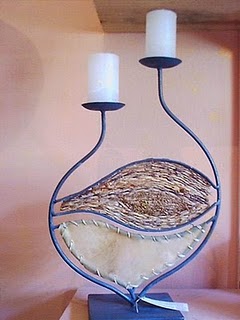
Decorative lamp by Silvia Umpiérrez.

Decorative lamp by Silvia Umpiérrez.

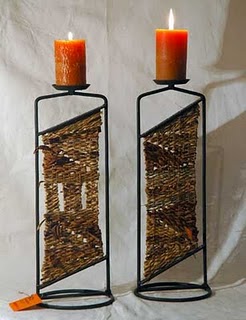
Left: Two of Silvia’s candle holders.

Photos at the bottom show raw materials before being woven into beautiful tapestries. Banana leaves and a great variety of twigs and sprays become part of the weft. The last picture is a detail of the finished tapestry.


Silvia Umpiérrez: tapestry (the "after" photo)

To see more of Silvia’s work, please go to her blog (in Spanish) at www.silviaumpierrez.blogspot.com

—Silvia Piza-Tandlich, translation


Jewelry with innovative materials and design

Gian Carlo Sandoval-Mazzero is a Costa Rican-born, Italy-educated architect and textile artist with a versatile mind, whose ability for design earned him the BID2010 AWARD for Costa Rica at the 2nd IberoAmerican Design Biennial 2010 in Madrid, Spain in Category, “Fashion, Textiles and Accessories.”

Information, observation and research led him to discover raw materials in unimaginable places: His Saturn collection is made with rescued orthodontic rubber, which he turns into very appealing jewelry.

Gian Carlo Sandoval-Mazzero- Saturn edition

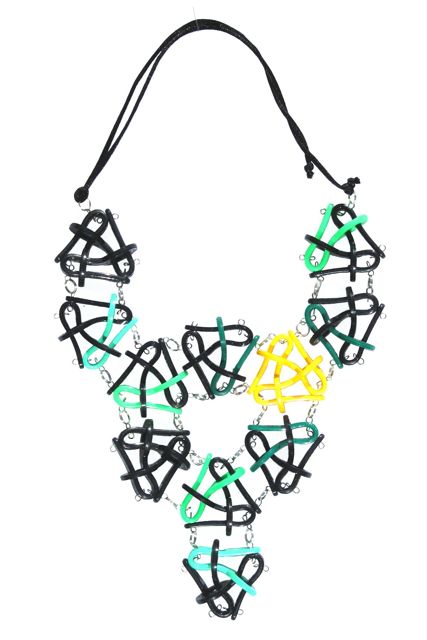
Gian Carlo Sandoval-Mazzero: Necklace. Edition 150 of the Unitá d'Italia.

Saturn gives contemporary jewelry a new dimension: It honors the art of recycling/upcycling by turning discarded material into a design object.  Research on the product allowed Gian Carlo a deeper understanding of the characteristics of the rubber material that he uses.

Gian Carlo Sandoval-Mazzero: Bracelet. Saturno Galileo edition.

He discovered that the product has a particular Antimicrobial Technology With Silver, which prevents the growth of microbes. At the same time, it does not contain latex, it is resistant to wear and tear, and it comes in a wide range of colors.

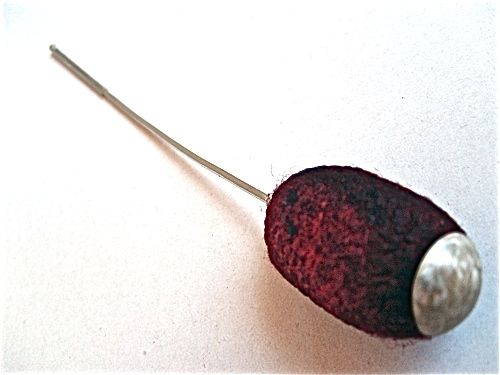
Gian Carlo Sandoval-Mazzero: brooch. Saturno Stadium collection.

These
characteristics, in addition to the use of stainless steel, silver, crystal and glass, produce innovative hypoallergenic jewels.

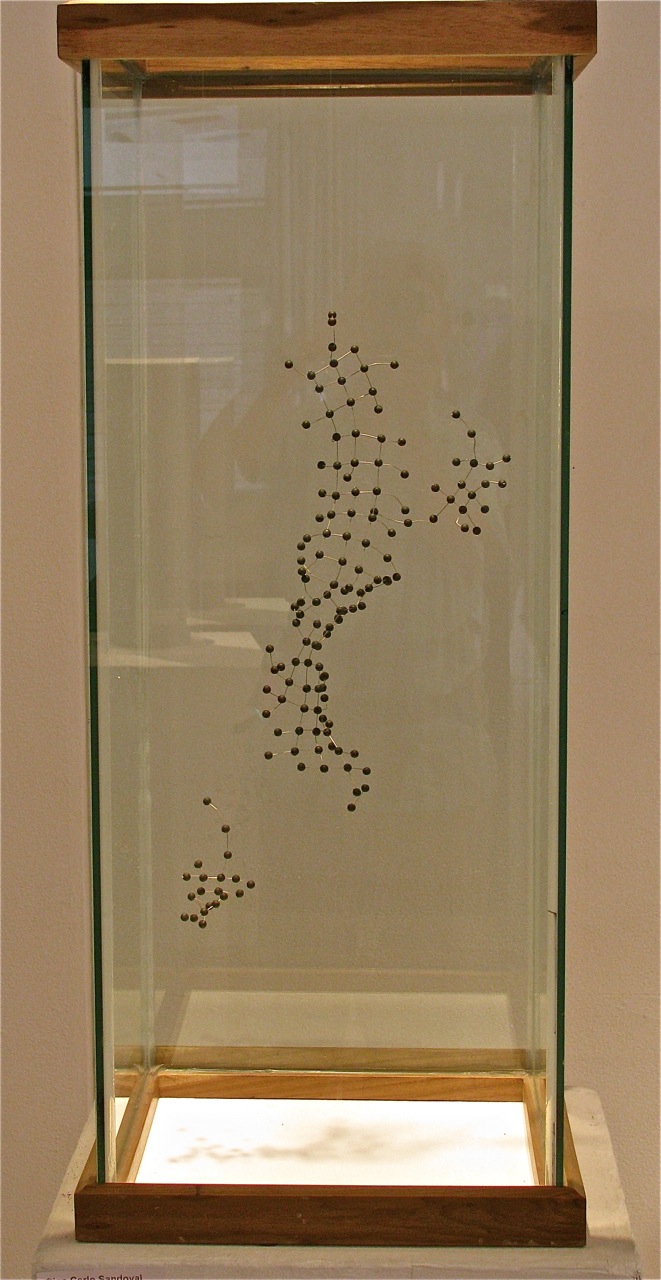
Sandoval-Mazzero- Textilis Contemporaneous edition

Work presented by Gian Carlo Sandoval-Mazzero at the main competition of the REDTEXTILIA Encounter (IberoAmerican Textile Network), September, 2010 at the Costa Rican-North American Cultural Center.

More information:    http://gotikadesign.blogspot.com 

—Silvia Piza-Tandlich, translation

WTA Biennial: Photos of winning works

The following are photographs of winning works,

Laura Ferrando (Argentina) "Cause Effect Action" - video

which is something—I suspect—we all love to see.

Ana Karen Allende Noriega (Mexico), "I will fight for your dreams"

Enjoy!

Anita Larkin (Australia) "Roger I hear you loud and clear”

If you’d like to have the work description for a particular artist’s piece, feel free to request at   sdarep@galeriaoctagono.com

Berta Jakubovic Teglio (Argentina) “Divinos Tiempos”

Most of the exhibits will be open to the public for about one more month.

Emilia Sandoval González (Mexico) “Tomado" ((Drunk))

Emily Jan (United States) “Dürer´s Rihnoceros ("A dream of elsewhere)”

Brigitte Amarger (France), "Weightlessness"

Anita Larkin-"Roger I hear you loud and clear”

Gerda Standaert (Belgium) “Woman from Afghanistan – I need air”

The Biennial is taking place in three different Mexican cities.

More than 300 artists participate in this event every two years.

Helvetia Kela Cremasque (Italy) “Anomos, el soplo vital”

Lilian Madfes (Uruguay) “Rojo y Carbón”

Joyce Rosner (USA): "Kite Study"

NEW IMPRESSIONS FROM BAMIYAN, AFGHANISTAN

The following is another description of Irene Carlos’s trip to Afghanistan. This is not a textile trip so far, but it is fascinating, indeed!

Dear Silvia, I don’t have internet (it took almost two days to find this small internet place.) When I get back to Guatemala I will try to send photos to upload on the blog.

From Kabul they placed me on a waiting list to travel to Bamiyan, the central region of Afghanistan.

In order to get to the Kabul airport one must go through several check and search points where traffic lines up at the entrance, so the taxi driver left me about 500 meters from the first search point.

As a woman, I had to enter the small rooms destined for checking luggage, handbags, breasts, hips, between legs and feet…two or three of these check points before looking for the gate for national flights. I made it in!

I board the helicopter, at last!, but after a few minutes the flight is suspended for security reasons. All of us unknown people, look at each other with expressions of WHAT? But for many this happens all the time, with the difference that they get picked up by their international office vehicles, whereas I get to pay a taxi again! Luckily they decide to wait many minutes together, and we finally fly. I can’t believe it!

Earth, sand, minerals, ocre, rose, grey, and suddenly a small oasis in green, with a creek coming down the snowy mountains. I wonder how they communicate with each other? Where are the roads? How do women give birth? Ahead, the IndoKush…so beautiful: the snowy peaks and then the greenest valley of all—Bamiyan! An Afghan man points at the empty space leftover from the 138 meter high Buddha statue. We’re there!

I’m in a small hostel with five white rooms and a terrace overlooking the potato and wheat fields, and beyond, the pink and brown mountain where the oldest Buddhist monastery used to be, with its 700 caves that once held their Lamas. It’s so spectacular and pristine after being in the cities of Herat and Kabul, that my heart gets overtaken with joy. There’s no electricity and everyone uses generators, candles, or solar panels.

A couple of Azara brothers have been so good to me and I really feel welcome. One of them took me to visit the remains of Buddhist temples. Something incredible. Now all the Bamiyan community is Azara, chiite.

Bamiyan is the only peaceful place in Afghanistan at the moment. Previously its kingdoms fought for centuries, forcing migration to mountains, Iran, or Pakistan from Shas and taliban during the last two centuries. Women don’t wear burkas although some sunni Pashtun women do.

Irene Carlos, Guatemalan painter and mixed media textile artist.

I, with all the layers of shawls and pashminas (fine cashmere wool covers), give myself away by my way of walking, my shoes or my eyeglasses—they’re not dark, but they’re made by some Italian designer having nothing to do here… A friend invited me to dinner with his wife. We ate basmati rice, roasted meat, fried potatoes and spinach, with watermelon for dessert… On the way home I realize that many bazaars become homes at night, and one can see people’s shadows as they spread the rugs on the floor to sleep…

I return to my room and tell myself how far away I am!

A strong hug to you from Irene Carlos.

—Silvia Piza-Tandlich

The power of association: Chile Crea Textil

CCT: Developing and spreading Chilean textile art

Reconstruct-us opening. Foreground: sdalatinREP, and CCT President Andrea Fischer. Background: U.S. artist Carol Westfall, and German artists Christine Altona and Helene Altona.

For many years in Chile some artistic expressions weren’t considered disciplines of high aesthetic value; textile art being one of them. Eventually, however, academic training and international contact—among many other factors, helped change around this situation. Nowadays the work of artists within this discipline is favored by greater receptiveness and appreciation of their proposals thanks to access to a wide range of creation possibilities, which is due to diversity and richness of technique and materials developed for centuries by first-settler artisans, mestizo country traditions, and urban creation.

Visitors browsing through the Reconstruct-us exhibit in Costa Rica.

In 2007, hoping to grow within their work and optimize the growing interest to cultivate this discipline, a group of Chilean textile artists formed a non-profit organization they named Chile Crea Textil (Chile Creates Textile). Since then they have worked to affiliate representatives of various textile creation and design modalities, establish a link to the academic world, share knowledge and information, and coordinate the participation of Chilean textile artists in biennial competitions, fairs, and international encounters.

Manuela Tromben: Works made with horse hair, silver, vegetable fibers, and yarn.

Carolina Morales. Necklaces. Linen/rayon mix, with closures made of ceramic, and silver.

Little by little, the work started by Chile Crea Textil has proved to be fruitful. One of the last presentations of Chilean textile art arranged by the Organization was at the “Encounter of the IberoAmerican Textile Network: Textile Creation, Sustainable Tradition, and Responsible Innovation,” which took place in September, 2010 in San José, Costa Rica. For that exhibit, the selection of Chilean textile works and contemporary jewelry by eleven artists and twelve contemporary textile jewelry designers, was amply recognized by its originality and high artistic level.

At the time of applying to the Costa Rican Encounter, Chile Crea Textil proposed a theme to be followed by Chilean artists wishing to participate: The earthquake that shook the country in 2010, and the concept of reconstruction, thus naming the exhibit Reconstruir-se (re-construct ourselves). Urged to ponder about the theme in question, the artists resorted to great creativity to develop their own distinctive work, which was marked by the identity of living in a land where movements from within the earth are commonplace, yet having been afflicted by one of the most intense earthquakes ever registered.

Contact CCT: http://www.chilecreatextil.cl/

Montserrat Lira: Necklaces woven with thermoplastic material.

Angélica Delgado & Eduardo Sepúlveda, Necklace. Fabric coiling, thread, metal.

——————————————————

From the same exposition is one of the wall pieces:

Constancia Urrutia: "Gestures"

—Silvia Piza-Tandlich, translation
CHILEAN JEWELRY EXHIBITORS

Montserrat Lira is one of the jewelry artists participating in the Reconstruct-us textile jewelry show in Costa Rica last September (see article above).

Montserrat Lira: Cocoon pin

She studied in Venezuela, Chile and the U.S. before dedicating her professional creativity solely to contemporary jewelry and teaching.
Montserrat uses materials such as felt, cocoons, woven nets, thermoplastic fibers, and polymers. Her main interest is the discovery and combination of techniques and materials in order to develop surfaces and textile objects featuring contemporary design with a strong visual and color impact.

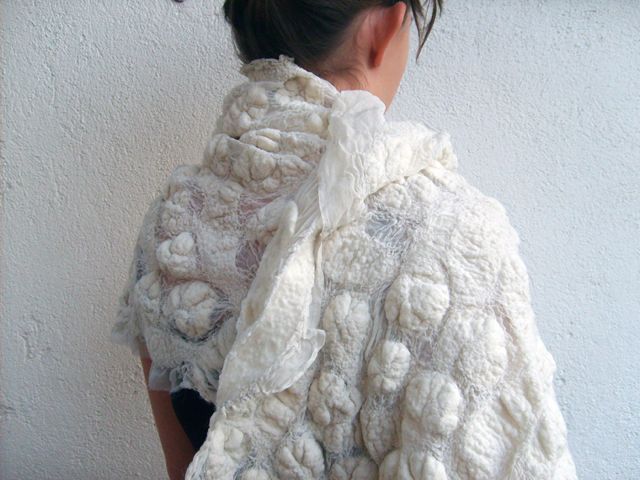
Montserrat Lira: Nuno felt shawl

In the area of education, Montserrat has taught dyeing techniques, stamping and felting for over 10 years in various design and fashion schools, and in her own studio.

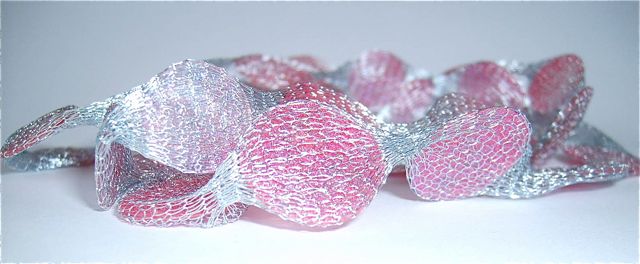
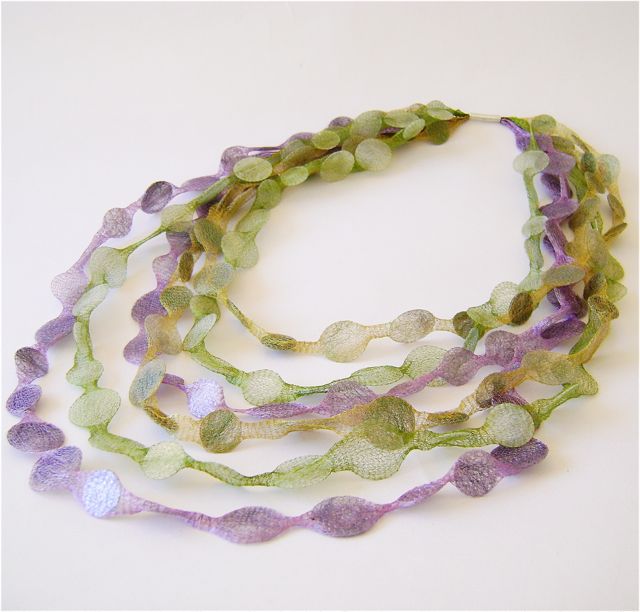
Montserrat Lira: Necklace

Montserrat Lira: Necklaces

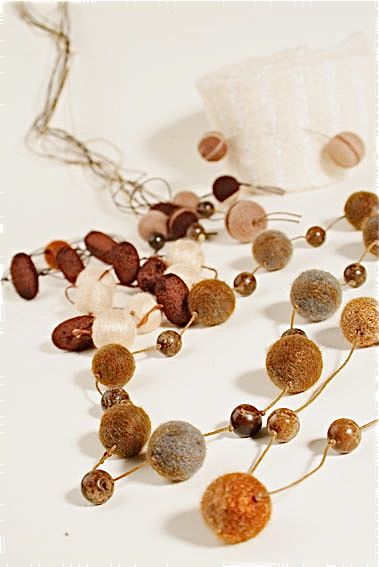
Montserrat Lira: Necklace featuring felt balls

Selected into the CREA National Chile Competition in 2009 and 2010, Montserrat also participated in the Reconstruct-us show featured above. Her contact information is      www.montserratlira.cl
 

—Silvia Piza-Tandlich, translation

Andrea Fischer creates textiles

Chilean ARTIST AND PROMOTER Andrea Fischer is founder and president of Chile Crea Textil (Chile Creates Textile, or CCT), an emerging association of textile creators whose 40 members produce an amazing body of work.

Andrea Fischer preparing her installation piece.

Andrea is also Vice-President of the IberoAmerican Textile Network, and a very active teacher of fiber and weaving techniques.
Her beautiful installation, Suspended IV, was an invited work at the Palais de Glace National Palace for the Arts in Buenos Aires, Argentina in 2009 during the 5th WTA Biennial. This work is based on bird nesting research made by the artist, and features 800 fiber eggs suspended from 200 threads, plus 650 threads carrying almost 12000 egg fragments.
Visit Andrea’s web site at   www.andreafischer.cl

Andrea Fischer photographing her installation.

Palais de Glace, Buenos Aires, Argentina

SUSPENDED IV, by Andrea Fischer.

—Silvia Piza-Tandlich, translation

Award winning jewelry made of paper

Textile jewelry design is gaining popularity worldwide, and there are LatinAmerican artists who take it to levels beyond our wildest imagination. Take Luis Acosta, for example: WOW!

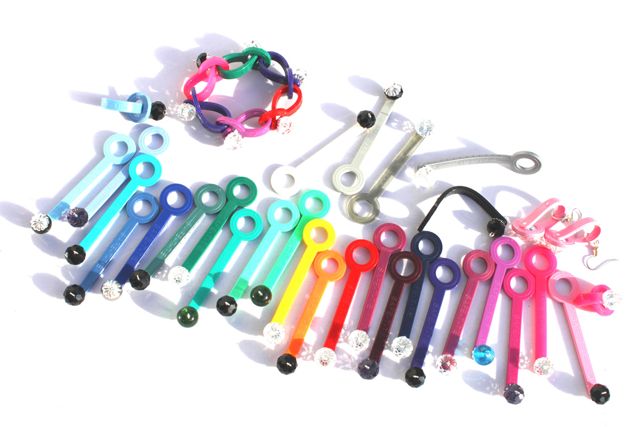
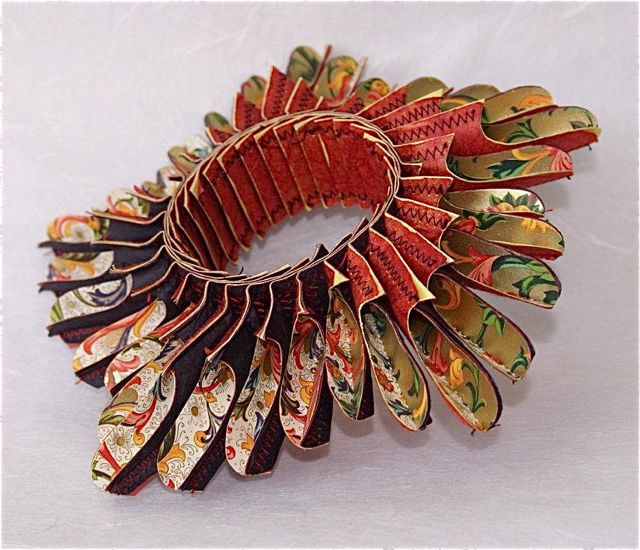
Luis Acosta: bracelet

Luis Acosta is originally from Córdoba, Argentina and lives in Holland. He studied weaving techniques at the Textile Department of the Gerrit Rietveld Academy in Amsterdam, where he graduated in 1988, but later committed his weft designs to paper. He made his first necklace in 1996 and, although it looked quite different from his present designs, it too, used the base of a relatively simple basic shape as starting point.

What he likes best about working with paper, is the infinite possibilities of combining colors and the different ways of working with paper sheets or paper threads. 

When asked where he gets his inspiration, he answers:

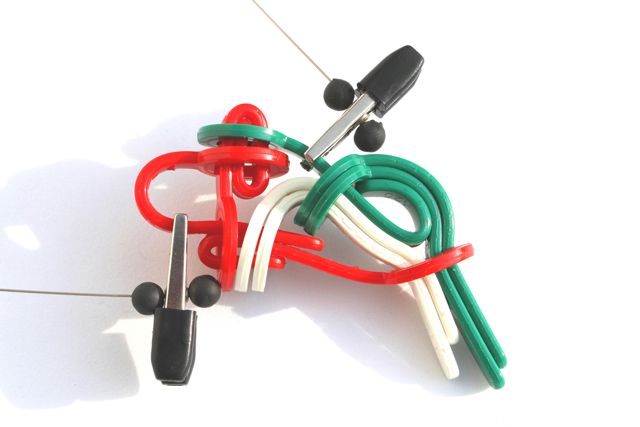
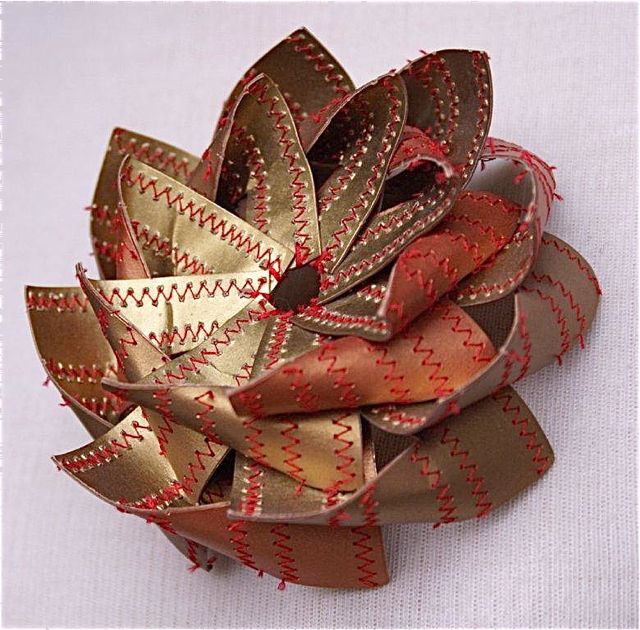
Luis Acosta: brooch

—”From simple forms I see daily everywhere. I develop a technique, draw a shape, and repeat, cut, and sew it.”


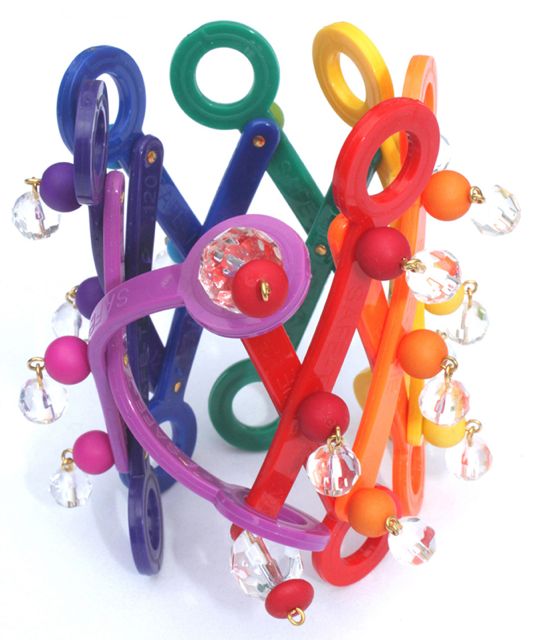
Luis Acosta: necklace

He has participated in group and individual exhibitions in most European countries, Argentina, USA, Japan and South Korea. There are works by Luis Acosta at the Museum of Arts and Design (New York, USA), Costume Museum (Buenos Aires, RA), Centre for the Arts Utrecht, The Textile Museum in Tilburg and in private collections in Argentina, Finland, India, Norway, Spain, Venezuela, USA and Netherlands.

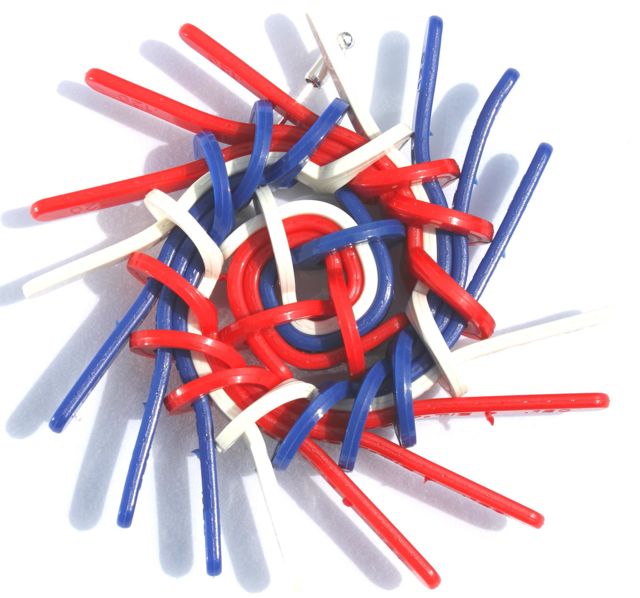
Necklace by Luis Acosta

Luis is part of the circle of members of the LAKMA, Latin American Art Museum of Netherlands. We first met as affiliates to an association we both joined in 2008. At that time, he was volunteering a lot of time to see the Latin American LAKMA wing become a reality.
He teaches courses in textile design and designing women’s accessories in Argentina, USA, Spain and the Netherlands.
Also designs, weaves and creates three-dimensional textile works and installations in (handmade) paper; tapestries and fabrics;  women’s accessories in various materials, and paper jewelry.

Luis is one of the semifinalist recipients of Contemporary Art and Craft Awards in Barcelona. Finalists will be announced during the ArtFad award giving ceremony on July 5, 2011. These awards are part of FadFest—an event organized by FAD (Fostering Arts & Design organization). See more at http://www.bellevuearts.org/exhibitions/current/think_twice/index.html

Luis Acosta: necklace

Contact the artist:  http://www.luisacosta.nl


—Silvia Piza-Tandlich, translation

Cartago BORDADO under Colombian sun

Photograph: /www.bordadosdecartago.com/

Cartago, Colombia – Cartago, in the department of Valle del Cauca, is undoubtedly one of the world’s prolific embroidery cradles. This Colombian area about 180 miles southwest from the capital city of Bogotá, exemplifies the rural simplicity, beauty, and fun rhythm of Colombia. The town is known nationally and internationally for its excellent embroidered textiles and apparel by artists who are true maestros of thread and needle.

Embroidery in the Valle del Cauca has developed from generation to generation to the point of making it a much appreciated regional tradition. Entire families in Cartago are devoted to this craft, dividing design and embroidery tasks among family members who embellish blouses, skirts, headbands, ruanas (poncho-like coats), guayaberas (traditional tropical shirts), bed and table linens, and more.

History of Cartago Embroidery– Spanish conquistadors brought the first hand-embroidered items to Cartago—a city they founded in 1540.

Hand embroidery became an institution since 1890 when the Vincentine sisters began to teach it in the school they ran. At the beginning, in colonial times, Spanish women were responsible for continuing the art of embroidery. Later on, mestizo women adopted the tradition and established small family enterprises that gradually obtained national and international acknowledgement and fame.

Characteristics of “Cartagüeno”

(carta/weh/no) Hand Embroidery

Cartago embroidery uses the floral and geometric design that characterizes Andalusian embroidery.

Four basic stitches are prominent: flat, crossed, looped, and knotted. Almost a hundred stitches are derived from the above, among which the best known are: cross stitch, stem stitch, cord stitch, relief stitch, flat-pass stitch, sand stitch, double Bastille, crow’s foot stitch, arrow stitch, star stitch, and angel stitch, among others.

Lately, natural materials from the Colombian flora—mainly banana leaf fibers and fique sisal (a xerophytic monocot native to the Andean regions of Colombia) are being added to traditional embroidery and have become fashionable in the textile industry.

I leave you with this fun Colombian cumbia video of Cartago so you can chair dance!

—Silvia Piza-Tandlich, translation